Question
  1. Obtain the expression for the cyclotron frequency.
  2. A deuteron and a proton are accelerated by the cyclotron. Can both be accelerated with the same oscillator frequency? Give reason to justify your answer.

Answer

  1. $\frac{mv^2}{r}=qvB$

$r=\frac{mv}{qB}$

Frequency of revolution $(v)=\frac{1}{Time\text{ }period}=\frac{v}{2\pi r}$

$v=\frac{qB}{2\pi m}$

  1. No The mass of the two particles, i.e deuteron and proton, is different. Since (cyclotron) frequency depends inversely on the mass, they cannot be accelerated by the same oscillator frequency.

Need a full question paper?

Generate a complete, print-ready paper with questions like this in minutes — across 16+ boards, with answer keys.

Start Generating Free

Similar questions

The equation for the vibration of a string, fixed at both ends vibrating in its third harmonic, is given by

$\text{y}=(0.4\text{cm})\sin\big[(0.314\text{cm}^{-1})\text{x}\big]\cos\big[(600\pi\text{s}^{-1})\text{t}\big]$
  1. What is the frequency of vibration?
  2. What are the positions of the nodes?
  3. What is the length of the string?
  4. What is the wavelength and the speed of two travelling waves that can interfere to give this vibration ?
Suppose an attractive nuclear force acts between two protons which may be written as $\text{F}=\text{Ce}^{-\text{kr}}/\text{r}^2.$
  1. Write down the dimensional formulae and appropriate SI units of C and k.
  2. Suppose that k = 1 fermi-1 and that the repulsive electric force between the protons is just balanced by the attractive nuclear force when the separation is 5 fermi. Find the value of C.
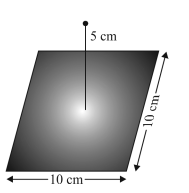
A point charge +10 µC is at a of distance 5 cm directly above the centre of a square of side 10 cm, as shown in Fig. What is the magnitude of the electric flux through the square? (Hint: Think of the square as one face of a cube with edge 10 cm.)
Image
A radio can tune over the frequency range of a portion of MW broadcast band: (800kHz to 1200kHz). If its LC circuit has an effective inductance of 200μH, what must be the range of its variable capacitor?
[Hint: For tuning, the natural frequency i.e., the frequency of free oscillations of the LC circuit should be equal to the frequency of the radiowave.]
Define mutual inductance between a pair of coils. Derive an expression for the mutual inductance of two long  coaxial solenoids of the same length wound one over the other.
Explain the experiment which represents the total internal reflection.
A flint glass prism and a crown glass prism are to be combined in such a way that the deviation of the mean ray is zero. The refractive index of flint and crown glasses for the mean ray are 1.620 and 1.518 respectively. If the refracting angle of the flint prism is 6.0°, what would be the refracting angle of the crown prism?
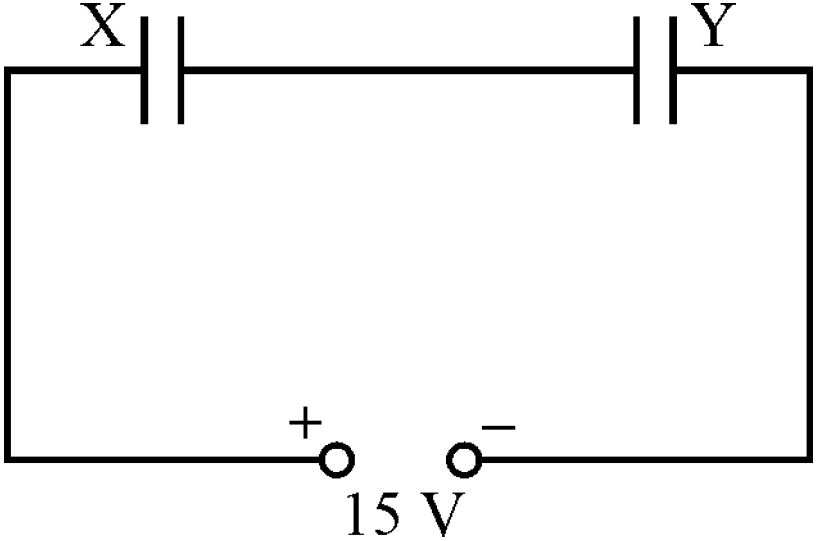
Two parallel plate capacitors X and Y have the same area of plates and same separation between them. X has air between the plates while Y contains a dielectric medium of $\varepsilon_{\text{r}} = 4.$

  1. Calculate capacitance of each capacitor if equivalent capacitance of the combination is $4\mu\text{f}.$
  2. Calculate the potential difference between the plates of X and Y.
  3. Estimate the ratio of electrostatic energy stored in X and Y.
The number density of free electrons in a copper conductor estimated in Example 3.1 is 8.5 × 1028 m-3. How long does an electron take to drift from one end of a wire 3.0 m long to its other end? The area of cross-section of the wire is 2.0 × 10-6 m2 and it is carrying a current of 3.0 A.
Repeat the previous exercise if the angle between each pair of springs is 120° initially.