Question
The equation for the vibration of a string, fixed at both ends vibrating in its third harmonic, is given by

$\text{y}=(0.4\text{cm})\sin\big[(0.314\text{cm}^{-1})\text{x}\big]\cos\big[(600\pi\text{s}^{-1})\text{t}\big]$

  1. What is the frequency of vibration?
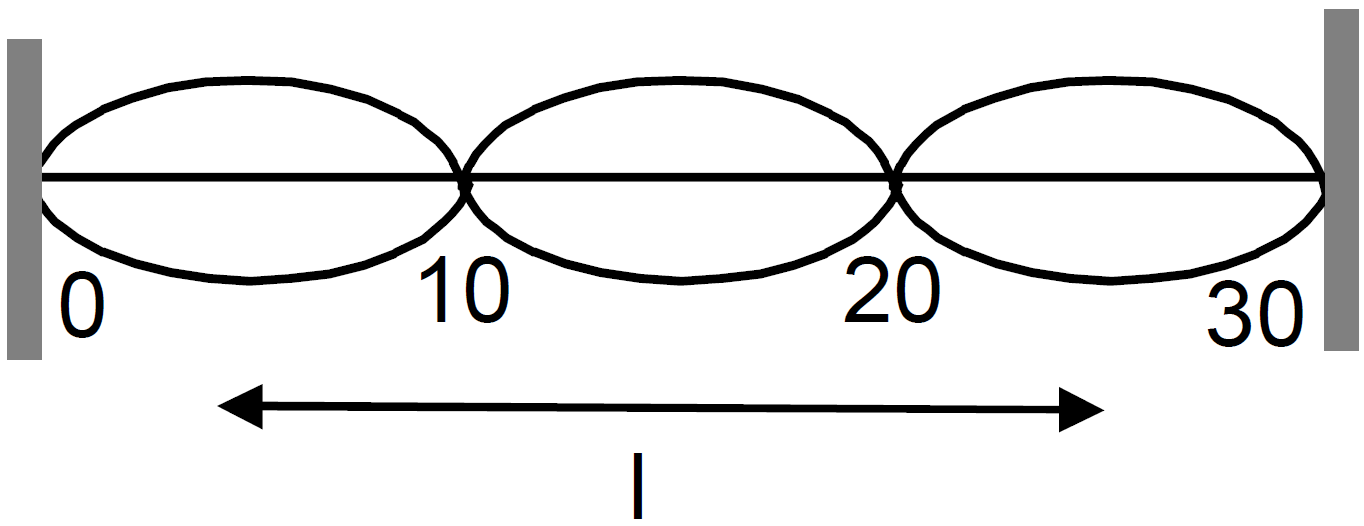
  2. What are the positions of the nodes?
  3. What is the length of the string?
  4. What is the wavelength and the speed of two travelling waves that can interfere to give this vibration ?
Answer

The stationary wave equation is given by

$\text{y}(0.4\text{cm})\sin\big[(0.314\text{cm}^{-1})\text{x}\big]\cos\big[(600\pi\text{s}^{-1})\text{t}\big]$

  1. $\omega=600\pi\Rightarrow2\pi\text{f}=600\pi\Rightarrow\text{f}=300\text{Hz}$

Wavelength,, $\lambda=\frac{2\pi}{0.314}=\frac{(2\times3.14)}{0.314}=20\text{cm}$

  1. Therefore nodes are located at, $0,\ 10\text{cm},\ 20\text{cm},\ 30\text{cm}$

  2. Length of the string $=\frac{3\lambda}{2}=3\times\frac{20}{2}=30\text{cm}$

  3. $\text{y}=0.4\sin(0.314\text{x})\cos(600\pi\text{t})$

$\Rightarrow0.4\sin\Big\{\big(\frac{\pi}{10}\big)\text{x}\Big\}\cos(600\pi\text{t})$

since $\lambda$ and v are the wavelength and velocity of the waves that interfere to give this vibration $\lambda=20\text{cm}$

$\text{v}=\frac{\omega}{\text{k}}=6000\text{cm/sec}=60\text{m/s}$

Need a full question paper?

Generate a complete, print-ready paper with questions like this in minutes — across 16+ boards, with answer keys.

Start Generating Free

Similar questions

  1. Write an expression of magnetic moment associated with a current (I) carrying circular coil of radius r having N turns.
  2. Consider the above mentioned coil placed in YZ plane with its centre at the origin. Derive expression for the value of magnetic field due to it at point (x, 0, 0).
A particle of mass m is projected with a speed u at an angle $\theta$ with the horizontal. Find the torque of the weight of the particle about the point of projection when the particle is at the highest point.
A charge of +2.0 × 10⁻⁸C is placed on the positive plate and a charge of -1.0 × 10⁻⁸C on the negative plate of a parallel-plate capacitor of capacitance $1.2\times10^{-3}\mu\text{F}.$ Calculate the potential difference developed between the plates.
A ball is dropped from a height. If it takes 0.200s to cross the last 6.00m before hitting the ground, find the height from which it was dropped. Take g = 10m/s2.
How many time constants will elapse before the charge on a capacitors falls to 0.1% of its maximum value in a discharging RC circuit?
State the principle of working of a galvanometer.
A galvanometer of resistance G is converted into a voltmeter to measure upto V volts by connecting a resistance R1 in series with the coil. If a resistance R2 is connected in series with it, then it can measure upto V/2 volts. Find the resistance, in terms of R1 and R2, required to be connected to convert it into a voltmeter that can read upto 2 V. Also find the resistance G of the galvanometer in terms of R1 and R2.
Explain emf, potential difference and internal resistance of cell and derive the relation between them. (or derive the relation between emf, potential difference and internal resistance of the cell.)
What is obtained by fusion of two deuterons?
A person sitting on the top of a tall building is dropping balls at regular intervals of one second. Find the positions of the 3rd, 4th and 5th ball when the 6th ball is being dropped.
A wheel rotating at a speed of 600rpm (revolutions per minute) about its axis is brought to rest by applying a constant torque for 10 seconds. Find the angular deceleration and the angular velocity 5 seconds after the application of the torque.