Question
Obtain the Ohm's law $j=\sigma$ E. Using this relation, establish the relation $V=I R$. What are ohmic and non-ohmic devices? Explain by giving examples.

Answer

SELF

Need a full question paper?

Generate a complete, print-ready paper with questions like this in minutes — across 16+ boards, with answer keys.
Start Generating Free

Similar questions

Do all the thermocouples have a neutral temperature?
i. What characteristic property of nuclear force explains the constancy of binding energy per nucleon (BE/A) in the range of mass number $A$ lying $30<A<170$ ?
ii. Show that the density of nucleus over a wide range of nuclei is constant and independent of mass number A
Define critical angle and write the conditions of total internal reflection.
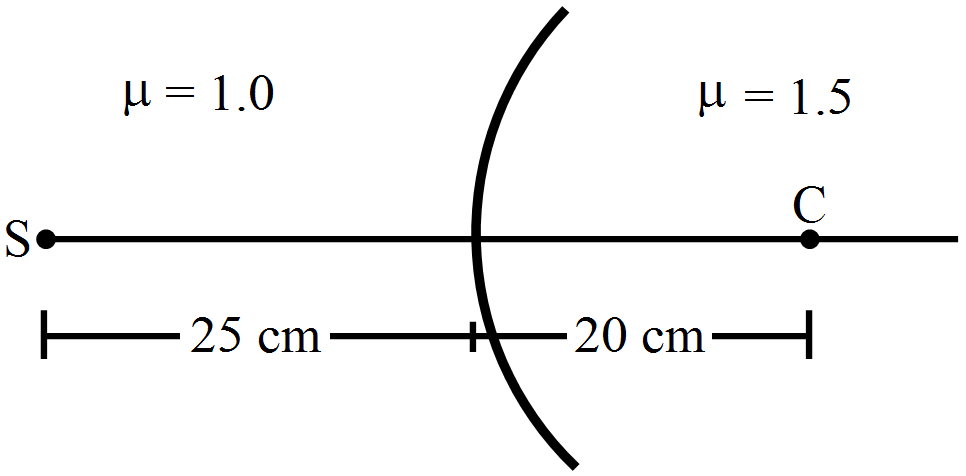
Locate the image formed by refraction in the situation shown in figure.
The work function for the following metals is given: $Na: 2.75 eV; K: 2.30 eV; Mo: 4.17 eV; Ni: 5.15 eV.$ Which of these metals will not give photoelectric emission for a radiation of wavelength $3300 \mathring A$ from a $He-Cd$ laser placed $1 m$ away from the photocell? What happens if the laser is brought nearer and placed $50 \ cm$ away?
The critical angle for a given piece of glass is $45^\circ$ . Calculate the polarising angle for it. Also calculate the angle of refraction when light is incident on this glass at an angle of incidence equal to $i_p$.
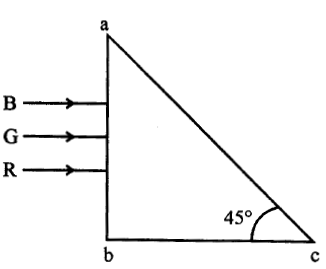
Three light rays red $(R)$, green $(G)$ and blue $(B)$ are incident on a right-angled prism $‘abc\ ’$ at face $‘ab\ ’$. The refractive indices of the material of the prism for red, green and blue wavelengths are $1.39, 1.44$ and $1.47$ respectively. Out of the three which colour ray will emerge out of face $‘ac\ ’$? Justify your answer. Trace the path of these rays after passing through face $‘ab\ ’.$
In a p-n junction, a potential barrier of 250meV exists across the junction. A hole with a kinetic energy of 300meV approaches the junction. Find the kinetic energy of the hole when it crosses the junction if the hole approached the junction.
  1. From the p-side.
  2. From the n-side.
Obtain the formula for the electric field due to a long thin wire of uniform linear charge density λ without using Gauss’s law.
[Hint: Use Coulomb’s law directly and evaluate the necessary integral.]
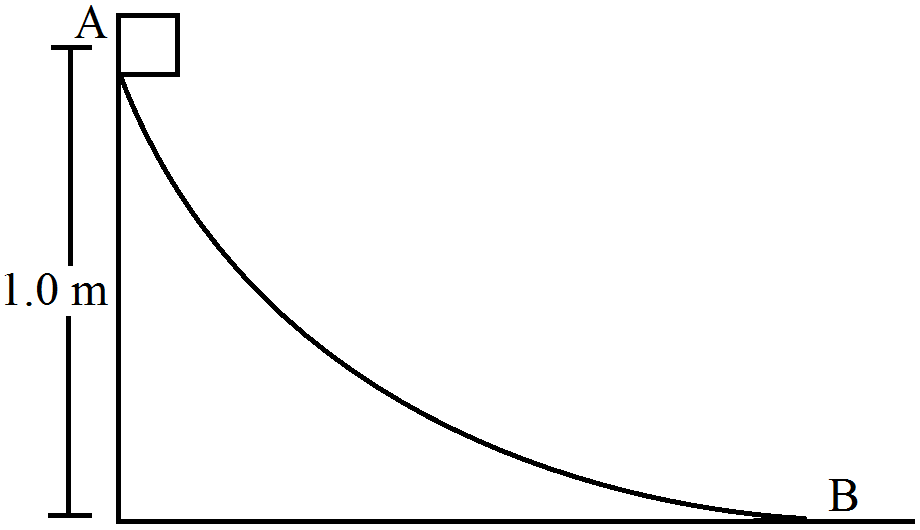
A block weighing 10N travels down a smooth curved track AB joined to a rough horizontal surface (figure). The rough surface has a friction coefficient of 0.20 with the block. If the block starts slipping on the track from a point 1.0m above the horizontal surface, how far will it move on the rough surface?