Question
The work function for the following metals is given: $Na: 2.75 eV; K: 2.30 eV; Mo: 4.17 eV; Ni: 5.15 eV.$ Which of these metals will not give photoelectric emission for a radiation of wavelength $3300 \mathring A$ from a $He-Cd$ laser placed $1 m$ away from the photocell? What happens if the laser is brought nearer and placed $50 \ cm$ away?
Answer

$Mo$ and $Ni$ will not show photoelectric emission in both cases
Wavelength for a radiation, $\lambda=3300\ \mathring{\text{A}}=3300\times10^{-10}\ \text{m}$
Speed of light, $c = 3 \times 10^8 m/s$
Planck's constant, $h = 6.6 \times 10^{-34} Js$
The energy of incident radiation is given as:
$\text{E}=\frac{\text{hc}}{\lambda}$
$=\frac{6.6\times10^{-34}\times3\times10^{8}}{3300\times10^{-10}}=6\times10^{-19}\ \text{J}$
$\frac{6\times10^{-19}}{1.6\times10^{-19}}=3.158\ \text{eV}$
It can be observed that the energy of the incident radiation is greater than the work function of $Na$ and $K$ only.
It is less for $Mo$ and $Ni.$
Hence, $Mo$ and $Ni$ will not show photoelectric emission.
If the source of light is brought near the photocells and placed $50 \ cm$ away from them,
then the intensity of radiation will increase. This does not affect the energy of the radfation.
Hence, the result will be the same as before.
However, the photoelectrons emitted from $Na$ and $K$ will increase in proportion to intensity.

Need a full question paper?

Generate a complete, print-ready paper with questions like this in minutes — across 16+ boards, with answer keys.

Start Generating Free

Similar questions

An inductor-coil, a capacitor and an AC source of rms voltage 24V are connected in series. When the frequency of the source is varied, a maximum rms current of 6.0A is observed. If this inductor coil is connected to a battery of emf 12V and internal resistance $4.0\Omega,$ what will be the current?
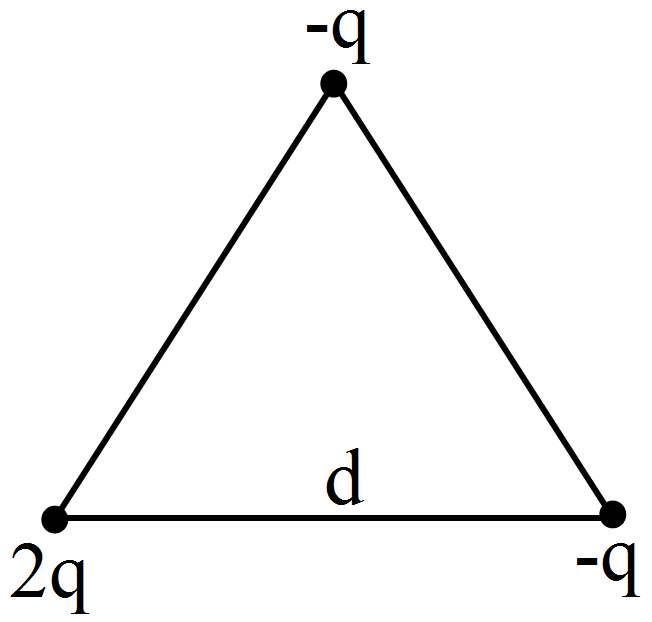
Three charges are arranged on the vertices of an equilateral triangle as shown in figure. Find the dipole moment of the combination.
A liquid$-$nitrogen container is made of a $1\ cm$ thick styrofoam sheet having thermal conductivity $0.025\text{Js}^{-1}\text{m}^{-1}{^\circ}\text{C}^{-1}.$ Liquid nitrogen at $80K$ is kept in it. A total area of $0.80m^2$ is in contact with the liquid nitrogen. The atmospheric temperature is $300K.$ Calculate the rate of heat flow from the atmosphere to the liquid nitrogen.
Half life of $^{238}\text{U}_{92}$against$\alpha$ decay is $4.5 \times 10^{9}$years. Calculate the activity of Ig sample of$^{238}\text{U}_{92}$? Given Avogadro's number $= 6 \times 10^{26}$atoms/kmol.
Radius of a disc of copper is 10 cm . It is rotating about an axis which is perpendicular to its plane and passing through its centre at the rate of $20 \pi rad /$ second. Uniform magnetic field of 0.2 T is working perpendicular to the disc. (i) Calculate potential difference between axis and circumference of the disc. (ii) If resistance of disc is 2 , then what is the magnitude of induced current?
Define the terms (i) drift velocity, (ii) relaxation time.
A conductor of length L is connected to a dc source of emf ε. If this conductor is replaced by another conductor of same material and same area of cross-section but of length 3L, how will the drift velocity change?
Write the definition of wavefront. Using Huygens' principle, draw the shape of a plane wave incident on a convex lens and the refracted wave body.
###
(a) When a wave propagates from a rarer medium to a denser medium, then which characteristic of that wave does not change and why?
(b) The refractive indices of two mediums are $\mu_1$ and $\mu_2$, what will be the ratio of velocities in the wave in them?
For a CE-transistor amplifier, the audio signal voltage across the collector resistance of 2 k$\Omega$ is 2 V. suppose the current amplification factor if the transistor is 100, find the input signal voltage and base current if the base resistance is 1 k$\Omega$.
State the Lenz's law regarding electromagnetic induction. This law is based on the conservation law of which quantity?
A horizontal conducting wire of length 2 m oriented in east-west direction is falling down with a speed of 5 m/s perpendicular to the horizontal component of earth's magnetic field of $0.3 \times 10^{-4} T.$ Calculate the instantaneous value of induced emf across the ends of the wire.
  1. How does one explain the emission of electrons from a photosensitive surface with the help of Einstein's photoelectric equation?
  2. The work function of the following metals is given: Na 2.75ev, K = 2.3 eV, Mo = 4.17eV and Ni = 5.15eV. Which of these metals will not cause photoelectric emission for radiation of wavelength 3300 Å from a laser source placed 1m away from these metals? What happens if the laser source is brought nearer and placed 50cm away?