Question
Obtain the relation between surface energy and surface tension.
Calculate the work done in blowing a soap bubble to a radius of $1 \ cm$. The surface tension of a soap solution is $2.5 \times 10^{-2} \ N / m$.
Answer

The relation between surface tension and surface energy:
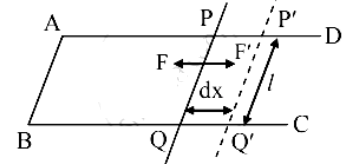
$i.$ Let $\text{ABCD}$ be a rectangular frame of wire, fitted with a movable arm $\text{PQ.}$
Image
$ii.$ The frame held in a horizontal position is dipped into a soap solution and taken out so that a soap film $\text{APQB}$ is formed. Due to the surface tension of the soap solution, a force $‘F \ ’$ will act on each arm of the frame. Under the action of this force, the movable arm $ \text{PQ}$ moves towards $\text{AB.}$
$iii$.The magnitude of force due to surface tension is, $F = 2Tl .....(\because T = F/l)$
$($A factor of $2$ appears because soap film has two surfaces that are in contact with a wire.$)$
$iv.$ Let the wire $PQ$ be pulled outwards through a small distance $‘dx \ ’$ to the position $P \ ′Q \ ′,$ by applying an external force $F \ ′$ isothermally, which is equal and opposite to $F.$ Work done by this force, $dW = F \ ′dx = 2Tldx.$
$v.$ But, $2ldx = dA =$ increase in the area of two surfaces of the film.
$\therefore dW = T dA$
$vi.$This work done in stretching the film is stored in the area $dA$ in the form of potential energy $($surface energy$).$
$\therefore$ Surface energy, $E = T dA$
$\therefore \frac{E}{d A}=T$
Hence, surface tension $=$ surface energy per unit area.
$vii.$Thus, surface tension is equal to the mechanical work done per unit surface area of the liquid, which is also called surface energy.
Given:
$T = 2.5 \times 10^{-2} N/m, r_1 = 0 m, r_2 = 1 \ cm = 10^{-2}m, W =$ ?
Formula:
$W =2 T dA =2 T \times 4 \pi\left(r_2^2-r_1^2\right)$
$\therefore W=2 \times 2.5 \times 10^{-2} \times 4 \pi \times 10^{-4}$
$\therefore W=6.283 \times 10^{-5} J$

Need a full question paper?

Generate a complete, print-ready paper with questions like this in minutes — across 16+ boards, with answer keys.

Start Generating Free

Similar questions

Assuming the expression for the pressure exerted by an ideal gas, prove that (1) the kinetic energy per mole of the gas $=\frac{3}{2}$ RT (2) the rms speed of a gas molecule, $\mathrm{u}_{\mathrm{rms}}=\sqrt{3 R T / M_0}$. OR
Assuming the expression for the pressure exerted by an ideal gas, show that the rms speed of a gas molecule is directly proportional to the square root of its absolute temperature.
OR
Show that the rms velocity of gas molecules is directly proportional to the square root of its absolute temperature.
Two simple harmonic progressive waves are represented by $y _1=2 \sin 2 \pi\left(100 t -\frac{x}{60}\right) cm$ and $y_2=2 \sin 2 \pi\left(100 t +\frac{x}{60}\right) cm$. The waves combine to form a stationary wave. Find
1. the amplitude at an antinode
2. the distance between adjacent node and antinode
3. the loop length
4. the wave speed.
What happens to a ferromagnetic material when its temperature increases above curie temperature?
Derive expressions for the period of SHM in terms of
(1) angular frequency
(2) force constant
(3) acceleration.
Explain the formulation of stationary waves by the analytical method. What are nodes and antinodes? Show that the distance between two successive nodes or antinodes is $\lambda/2.$
Coefficient of static friction between a coin and a gramophone disc is 0.5. Radius of the disc is 8 cm. Initially the
centre of the coin is 2 cm away from the centre of the disc. At what minimum frequency will it start slipping from there? By what factor will the answer change if the coin is almost at the rim?
(use $g=\pi^2 m / s ^2$ )
 
Define the angular momentum of a particle.
Obtain an expression for the electric potential energy of a system of two isolated point charges.
A horizontal force of $1 N$ is required to move a metal plate of area $10^{-2} m ^2$ with a velocity of $2 \times 10^{-2} m / s$, when it rests on a layer of oil $1.5 \times 10^{-3} m$ thick. Find the coefficient of viscosity of oil.
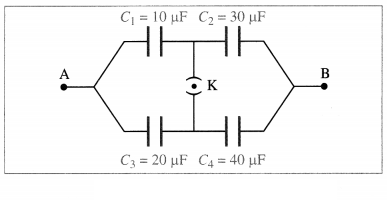
In below figure, $C_1=10 \mu F_r\  C_2=30 \mu F_x\  C_3=20 \mu F_r\  C_4=40 \mu F$. Find the capacitance between the points $A$ and $B$ when $(i)$ the key $K$ is closed $(ii)$ the key $K$ is open.
Image