Question
What happens to a ferromagnetic material when its temperature increases above curie temperature?

Answer


A ferromagnetic material is composed of small regions called domains. Within each domain, the atomic magnetic moments of nearest-neighbour atoms interact strongly through exchange interaction, a quantum mechanical phenomenon, and align themselves parallel to each other even in the absence of an external magnetic field. A domain is, therefore, spontaneously magnetized to saturation.
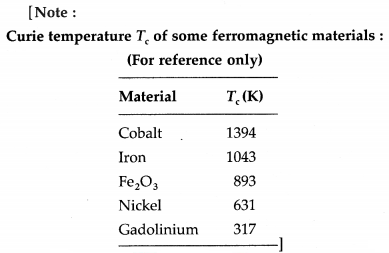
The material retains its domain structure only up to a certain temperature. On heating, the increased thermal agitation works against the spontaneous domain magnetization. Finally, at a certain critical temperature, called the Curie point or Curie temperature, thermal agitation overcomes the exchange forces and keeps the atomic magnetic moments randomly oriented. Thus, above the Curie point, the material becomes paramagnetic. The ferromagnetic to paramagnetic transition is an order to disorder transition. When cooled below the Curie point, the material becomes ferromagnetic again.
Image

Need a full question paper?

Generate a complete, print-ready paper with questions like this in minutes — across 16+ boards, with answer keys.

Start Generating Free

Similar questions

Prove the law of conservation of energy for a particle performing simple harmonic motion. Hence graphically show the variation of kinetic energy and potential energy w. r. t. instantaneous displacement.
State the importance of Davisson and Germer experiment.
Answer in brief:
Explain the spectral distribution of blackbody radiation.
Compare the rates of emission of heat by a blackbody maintained at 727ºC and at 227ºC, if the black bodies are surrounded
by an enclosure (black) at 27ºC. What would be the ratio of their rates of loss of heat ?
 
Express Faraday-Lena's law of electromagnetic induction in an equation form.
The semi vertical angle of the cone of the rays incident on the objective of a microscope is $20^{\circ}$. If the wavelength of incident light is $6600 Å$, calculate the smallest distance between two points which can be just resolved.
The equivalent capacitance of two capacitors is $6 \mu F$ when they are connected in series and $25 \mu F$ when they are connected in parallel. Find the capacitance of each capacitor.
A set of $8$ tuning forks is arranged in a series of increasing order of frequencies. Each fork gives $4$ beats per second with the next one and the frequency of last for $k$ is twice that of the first. Calculate the frequencies of the first and the last for $k.$ [Ans:$28\ Hz, 56\ Hz$]
State and prove Kirchoff’s law of heat radiation.
Calculate the energy released in the following reactions, given the masses to be ${ }_{88}^{223} Ra$ : $223.0185 u _8^{209} Pb : 208.9811,{ }_6^{14} C : 14.00324,{ }_{92}^{236} U : 236.0456,{ }_{56}^{140} Ba : 139.9106,{ }_{36}^{94} Kr$ : 93.9341, ${ }_6^{11} C : 11.01143,{ }_5^{11} B : 11.0093$. Ignore neutrino energy.
(a) ${ }_{88}^{223} Ra \rightarrow{ }_{82}^{209} Pb +{ }_6^{14} C$
(b) ${ }_{92}^{836} U \rightarrow{ }_{56}^{140} Ba +{ }_{36}^{94} Kr +2 n$
(c) ${ }_6^{11} C \rightarrow{ }_5^{11} B + e ^{+}+$neutrino