MCQ
Of the following, the one with largest size is
- ✓$C{l^ - }$
- B$Ar$
- C${K^ + }$
- D$C{a^{2 + }}$
$Cl ^{-}-1 s ^2 2 s ^2 2 p ^6 3 s ^2 3 p ^6$
It has 18 electrons and $17$ protons
Ar $-1 s^2 2 s^2 2 p^6 3 s^2 3 p^6$
It has 18 electrons and $18$ protons
$K ^{+}-1 s ^2 2 s ^2 2 p ^6 3 s ^2 3 p ^6$
It has 18 electrons and 19 protons
$Ca ^{2+}-1 s ^2 2 s ^2 2 p ^6 3 s ^2 3 p^6$
It has 18 electrons and $20$ protons
From this information, we can easily conclude that $Cl ^{-}$would be the largest because it has a higher number of electrons as compared to protons and so the 'effective nuclear charge' would be lower on each electron.
Generate a complete, print-ready paper with questions like this in minutes — across 16+ boards, with answer keys.
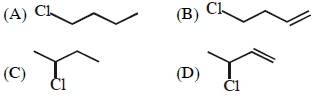
Method $1\,:\,$ $RBr\xrightarrow[diethyl\,\,ether]{Mg}RMgBr\xrightarrow[2.\,{{H}_{3}}{{O}^{+}}]{1.\,C{{O}_{2}}}RC{{O}_{2}}H$
Method $2\,:\,$ $RBr\xrightarrow{NaCN}RCN\xrightarrow[heat]{{{H}_{2}}O,HCl}RC{{O}_{2}}H$
Which one of the following statements correctly describes this conversion ?