MCQ
Oil spreads over the surface of water whereas water does not spread over the surface of the oil, due to
  • Surface tension of water is very high
  • B
    Surface tension of water is very low
  • C
    Viscosity of oil is high
  • D
    Viscosity of water is high

Answer

Correct option: A.
Surface tension of water is very high
a
Oil spreads over the surface of water whereas water does not spread over the surface of the oil because Surface tension of water is very high.

Need a full question paper?

Generate a complete, print-ready paper with questions like this in minutes — across 16+ boards, with answer keys.
Start Generating Free

Similar questions

Water rises upto $10\, cm$ height in a long capillary tube. If this tube is immersed in water so that the height above the water surface is only $8 \,cm,$  then
An ideal gas undergoes isothermal process from some initial state $i$ to final state $f.$ Choose the correct alternatives.
On increasing number density for a gas in a vessel, mean free path of a gas
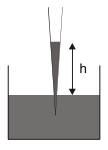
A glass capillary tube is of the shape of a truncated cone with an apex angle $\alpha$ so that its two ends have cross sections of different radii. When dipped in water vertically, water rises in it to a height $h$, where the radius of its cross section is $b$. If the surface tension of water is $S$, its density is $\rho$, and its contact angle with glass is $\theta$, the value of $h$ will be ( $g$ is the acceleration due to gravity)
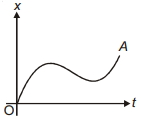
The position-time graph for a body moving along a straight line between $O$ and $A$ is shown in figure. During its motion between $O$ and $A$, how many times body comes to rest?
If the atmospheric pressure is $P_a$, then the pressure $P$ at depth $h$ below the surface of liquid of density $\rho $ open to the atmosphere is
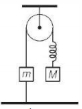
An arrangement of spring, strings, pulley and masses is shown in the figure below.The pulley and the strings are massless and $M>m$. The spring is light with spring constant $k$. If the string connecting $m$ to the ground is detached, then immediately after detachment
A light pointer fixed to one prong of a tuning fork touches a vertical plate. The fork is set vibrating and the plate is allowed to fall freely. If eight oscillations are counted when the plate falls through $10 cm$, the frequency of the tuning fork is .... $Hz$
$70$ calories of heat are required to increase the temperature of $2$ moles of an ideal gas from $30^\circ C$ to $35^\circ C$ at constant pressure. The amount of heat required to increase the temperature of the same gas through same temperature range $(30^\circ C$ to $35^\circ C)$ at constant volume will be $\text{(R = 2cal/ mole/ K).}$
The specific heat at constant pressure and at constant volume for an ideal gas are ${C_p}$ and ${C_v}$ and its adiabatic and isothermal elasticities are ${E_\varphi }$ and ${E_\theta }$ respectively. The ratio of ${E_\varphi }$ to ${E_\theta }$ is