MCQ
On a clear sunny day, an object at temperature $T$  is placed on the top of a high mountain. An identical object at the same temperature is placed at the foot of mountain. If both the objects are exposed to sun-rays for two hours in an identical manner, the object at the top of the mountain will register a temperature
  • A
    Higher than the object at the foot
  • Lower than the object at the foot
  • C
    Equal to the object at the foot
  • D
    None of the above

Answer

Correct option: B.
Lower than the object at the foot
b
(b) Because of uneven surfaces of mountains, most of it's parts remain under shadow.

So, most of the mountains. Land is not heated up by sun rays.

Besides this, sun rays fall slanting on the mountains and are spread over a larger area.

So, the heat received by the mountains top per unit area is less and they are less heated compared to planes (Foot).

Need a full question paper?

Generate a complete, print-ready paper with questions like this in minutes — across 16+ boards, with answer keys.

Start Generating Free

Similar questions

A small particle of mass $m$ moving inside a heavy, hollow and straight tube along the tube axis undergoes elastic collision at two ends. The tube has no friction and it is closed at one end by a flat surface while the other end is fitted with a heavy movable flat piston as shown in figure. When the distance of the piston from closed end is $L = L _0$ the particle speed is $v = v _0$. The piston is moved inward at a very low speed $V$ such that $V \ll \frac{ dL }{ L } v _0$, where $dL$ is the infinitly small displacement of the piston. Which of the following statement($s$) is/are correct?

$(1)$ The rate at which the particle strikes the piston is $v / L$

$(2)$ After each collision with the piston, the particle speed increases by $2 V$

$(3)$ The particle's kinetic energy increases by a factor of $4$ when the piston is moved inward from $L _0$ to $\frac{1}{2} L _0$

$(4)$ If the piston moves inward by $d L$, the particle speed increases by $2 v \frac{d L}{L}$

A man is running with constant speed along a circular path of radius $2 \sqrt 2\, m$. He completes $1$ round in $10\, second$. Find instantaneous speed at $2.5 \,sec.$
When $20\ \text{cal}$ of heat is supplied to a system, the increase in internal energy is $50J$. If the external work done is $35J$, the mechanical equivalent of heat is:
A wind with speed $40\,\, m/s$ blows parallel to the roof of a house. The area of the roof is $250\, m^2.$ Assuming that the pressure inside the house is atmospheric pressure, the force exerted by the wind on the roof and the direction of the force will be  $(\rho _{air} = 1.2  \,\,kg/m^3)$ 
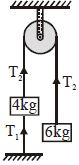
Two bodies of mass $4\,kg$ and $6\,kg$ are attached to the ends of a string passing over a pulley. A $4\,kg$ mass is attached to the table top by another string. The tension in this string $T_1$ is equal to ......... $N$
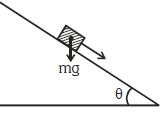
A plank with a box on it at one end is gradually raised about the other end. As the angle of inclination with the horizontal reaches $30^o$, the box starts to slip and slides $4.0\, m$ down the plank in $4.0\,s$. The coefficients of static and kinetic friction between the box and the plank will be, respectively
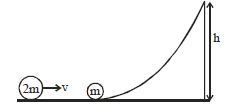
A ball of mass $2\,m$ is moving with velocity $v$ on a smooth surface collides elastically headon with another ball of mass $m$. If ball of mass $m$ reaches upto top of frictionless elevated plane, then velocity $v$ of heavy ball must be
Pick out the statement which is not true
A liquid is kept in a cylindrical jar, which is rotated about the cylindrical axis. The liquid rises at its ends. The radius of the jar is $r$ and speed of rotation is $\omega$. The difference in height at the centre and the sides of jar is
Which of the following diagrams $($figure$)$ depicts ideal gas behaviour?