Question
On all points of rectangular hyperbola demand curve, elasticity of demand is:
  1. Equal to unity.
  2. Zero.
  3. Greater than unity.
  4. Less than unity.

Answer

  1. Equal to unity.

Need a full question paper?

Generate a complete, print-ready paper with questions like this in minutes — across 16+ boards, with answer keys.
Start Generating Free

Similar questions

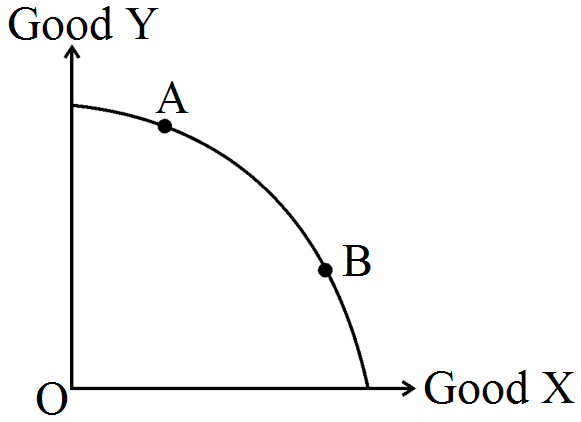
Shape of PPC is:
  1. Downward slopping concave to the origin
  2. Downward sloping convex to the origin
  3. Downward sloping straight line to the origin
  4. All of the above
The supply of a commodity implies:
  1. Actual product of a good.
  2. Stock available for sale.
  3. Total existing stock of the good.
  4. The amount of goods offered for sale at a different prices, per unit of time.
Giffen paradox is an exception of _______:
  1. Law of Demand.
  2. Law of Supply.
  3. Law of Production.
  4. Law of Utility.
If Marginal Rate of Substitution is increasing throughout, the Indifference Curve will be: (Choose the correct alternative)
  1. Downward sloping convex.
  2. Downward sloping concave.
  3. Downward sloping straight line.
  4. Upward sloping convex.
Price elasticity of demand is _______ in number because price and quantity demanded are inversely related:
  1. Positive.
  2. Negative.
  3. Constant.
  4. Prime.
Which of the following cost decreases continuously with increase in production?
  1. Total Variable Cost.
  2. Marginal Cost.
  3. Average Total Cost.
  4. Average Fixed Cost.
Average product is defined as:
  1. Total product divided by the total cost.
  2. Total product divided by the marginal product.
  3. Total product divided by the variable input.
  4. Marginal product divided by the variable input.
What is the relation between price and marginal cost at equilibrium, when price falls with the rise in output.
  1. Price = Marginal Cost.
  2. Price > Marginal Cost.
  3. Price < Marginal cost.
  4. None of these.