On an electric heater $220\, volt$ and $1100\, watt$ are marked. On using it for $4$ hours, the energy consumed in $kWh$ will be
Easy
Download our app for free and get started
(b) $E = \frac{{1100 \times 4}}{{1000}} = 4.4\,\,kWh$

Download our appand get started for free
Experience the future of education. Simply download our apps or reach out to us for more information. Let's shape the future of learning together!No signup needed.*
Similar Questions
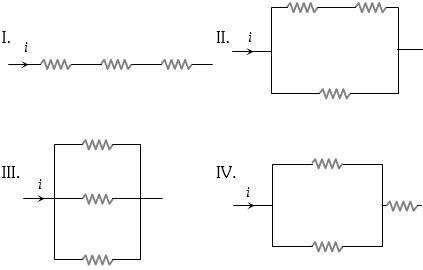
- 1View SolutionThe three resistance of equal value are arranged in the different combinations shown below. Arrange them in increasing order of power dissipation.
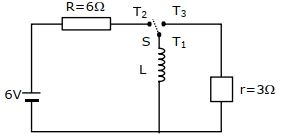
- 2Consider an electrical circuit containing a two way switch $^{\prime}{S}^{\prime}$. Initially ${S}$ is open and then ${T}_{1}$ is connected to ${T}_{2} .$ As the current in ${R}=6 \,\Omega$ attains a maximum value of steady state level, ${T}_{1}$ is disconnected from ${T}_{2}$ and immediately connected to ${T}_{3} .$ Potential drop across ${r}=3\, \Omega$ resistor immediately after $T_{1}$ is connected to $T_{3}$ is $....\,V.$ (Round off to the Nearest Integer)View Solution
- 3Two resistances are joined in parallel whose resultant is $\frac{6}{8}\,ohm$. One of the resistance wire is broken and the effective resistance becomes $2\,\Omega $. Then the resistance in ohm of the wire that got broken wasView Solution
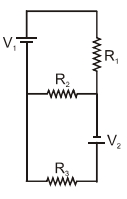
- 4Two ideal batteries of emf $V _1$ and $V _2$ and three resistances $R _1, R _2$ and $R _3$ are connected as shown in the figure.View Solution
The current in resistance $R _2$ would be zero if
$(A)$ $V_1=V_2$ and $R_1=R_2=R_3$
$(B)$ $V_1=V_2$ and $R_1=2 R_2=R_3$
$(C)$ $V_1=2 V_2$ and $2 R_1=2 R_2=R_3$
$(D)$ $2 V _1= V _2$ and $2 R _1= R _2= R _3$
- 5A $d.c.$ main supply of $e.m.f.\, 220\, V$ is connected across a storage battery of $e.m.f.\, 200\, V$ through a resistance of $1\,\Omega $. The battery terminals are connected to an external resistance $'R'$ . The minimum value of $'R'$, so that a current passes through the battery to charge it is ............... $\Omega$View Solution
- 6View SolutionThe resistivity of a wire
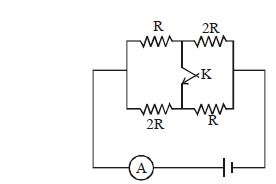
- 7View SolutionFind the ratio of currents as measured by ammeter in two cases when the key is open and when the key is closed
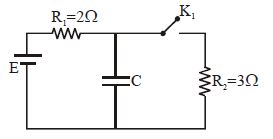
- 8In the circuit shown in the figure $K_1$ is open. The charge on capacitor $C$ in steady state is $q_1$. Now key is closed and at steady state charge on $C$ is $q_2$. The ratio of charges $q_1/q_2$ isView Solution
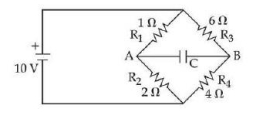
- 9The charge accumulated on the capacitor connected in the following circuit is________ $\mu \mathrm{C}$ (Given $\mathrm{C}=150\ \mu \mathrm{F}$ )View Solution
- 10View SolutionEmf is most closely related to