MCQ
On colliding in a closed container the gas molecules
  • Transfer momentum to the walls
  • B
    Momentum becomes zero
  • C
    Move in opposite directions
  • D
    Perform Brownian motion

Answer

Correct option: A.
Transfer momentum to the walls
a

Need a full question paper?

Generate a complete, print-ready paper with questions like this in minutes — across 16+ boards, with answer keys.
Start Generating Free

Similar questions

If a force of $250\, N$ act on body, the momentum acquired is $125\, kg-m/s$. What is the period for which force acts on the body  ......... $\sec$
When a rubber ball is taken to the bottom of a sea of depth $1400 \,m$, its volume decreases by $2 \%$. The Bulk modulus of rubber ball is .................. $\times 10^8 N / m ^2$ [density of water is $1 \,g cc$ and $g=10 \,m / s ^2$ ]
The potential energy of a particle varies with distance $x$ from a fixed origin as $U\, = \,\frac{{A\sqrt x }}{{{x^2} + B}}$ Where $A$ and $B$ are dimensional constants then find the dimensional formula for $A/B$
A horizontal circular loop carries a current that looks clockwise when viewed from above. It is replaced by an equivalent magnetic dipole consisting of a south pole S and a north pole N:
  1. The line SN should be along a diameter of the loop.
  2. The line SN should be perpendicular to the plane of the loop.
  3. The south pole should be slow the loop.
  4. The north pole should be below the loop.
Vapour is injected at a uniform rate in a closed veseel which was initially evacuated. The pressure in the vessel:
  1. Increaaes continuously.
  2. Decreases continuously.
  3. First increases and then decreases.
  4. First increases and then becomes constant.
Water droplets are coming from an open tap at particular rate. The spacing between a droplet observed at $4^{{th}}\;second$ after its fall to the next droplet is $34.3 \,{m}$. At what rate the droplets are coming from the tap ? (Take $g=9.8\, {m} / {s}^{2}$)
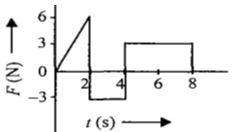
The force $F$ acting on a particle of mass $m$ is indicated by the force-time graph shown below. The change in momentum of the particle over the time interval from zero to $8\, s$ is   .......... $N-s$
A particle is moving along a curve. Then
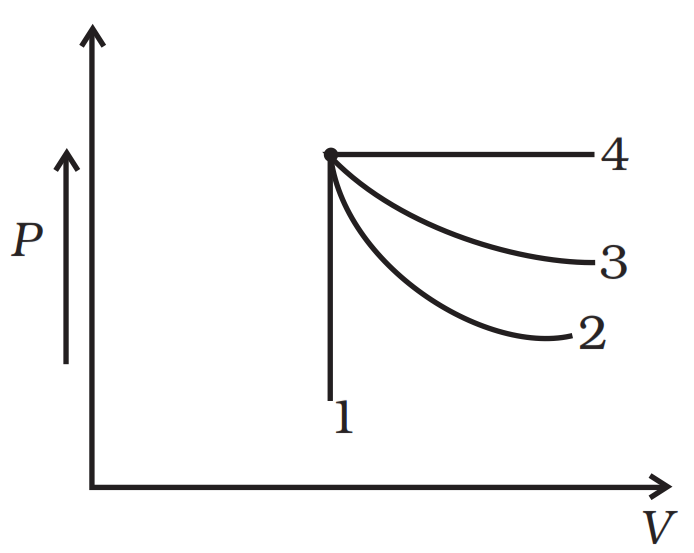
An ideal gas undergoes four different processes from thesame initial state (Fig.). Four processes are adiabatic, isothermal, isobaric and isochoric. Out of 1, 2, 3 and 4 whichone is adiabatic.

A particle moves in space along the path $z = ax^3 + by^2$ in such a way that $\frac{dx}{dt} = c = \frac{dy}{dt}.$ Where $a, b$ and $c$ are contants. The acceleration of the  particle is