MCQ
On doubling the distance between two masses, the gravitational force between the masses:
  • A
    Will remain unchanged
  • Will be quartered
  • C
    Will remain half
  • D
    Will double

Answer

Correct option: B.
Will be quartered
B

Need a full question paper?

Generate a complete, print-ready paper with questions like this in minutes — across 16+ boards, with answer keys.
Start Generating Free

Similar questions

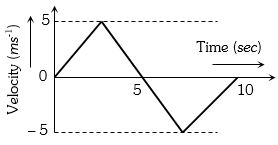
The $v- t$ plot of a moving object is shown in the figure. The average velocity of the object during the first $10$ seconds is...........$m/s$
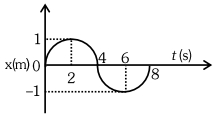
The $x-t$ graph of a particle performing simple harmonic motion is shown in the figure. The acceleration of the particle at $t=2 s$ is :
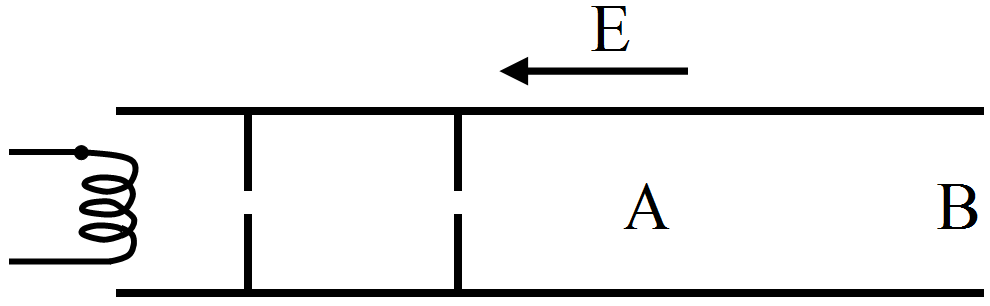
Electrons are emitted by a hot filament and are accelerated by an electric field, as shown in the figure. The two stops at the left ensure that the electron beam has a uniform cross-section.

  1. The speed of the electrons is more at B than at A.
  2. The electric current is from left to right.
  3. The magnitude of the current is larger at B than at A.
  4. The current density is more at B than at A.
A container is divided into two equal parts $I$ and $II$ by a partition with a small hole of diameter $d$. The two partitions are filled with same ideal gas, but held at temperatures $T_{ I }=150 \,K$ and $T_{ II }=300 \,K$ by connecting to heat reservoirs. Let $\lambda_{1}$ and $\lambda_{1 I}$ be the mean free paths of the gas particles in the two parts, such that $d >> \lambda_{ I }$ and $d >> \lambda_{ II }$. Then, the $\lambda_{ I } / \lambda_{ II }$ is close to
If the radius of curvature of the path of two particles of same mass are in the ratio $3:4,$ then in order to have constant centripetal force, their velocities will be in the ratio of:
For a particle of a rotating rigid body, $\text{v}=\text{r}\omega,\text{So}$
$Assertion : $ Machine parts are jammed in winter.
$Reason :$ The viscosity of lubricant used in machine parts increase at low temperatures.
On increasing number density for a gas in a vessel, mean free path of a gas
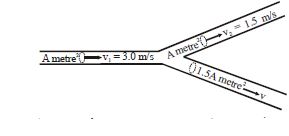
An incompressible liquid flows through a horizontal tube as shown in the figure. Then, the velocity $v$ of the fluid is ......... $m/s$
When we hear a sound, we can identify its source from