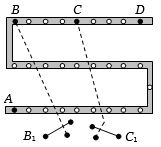
On increasing the temperature of a conductor, its resistance increases because
Easy


Download our appand get started for free
Experience the future of education. Simply download our apps or reach out to us for more information. Let's shape the future of learning together!No signup needed.*
Similar Questions
- 1A wire $50\, cm$ long and $1\;mm^2$ in cross -section carries a current of $4\; A$ when connected to a $2\; V$ battery. The resistivity of the wire isView Solution
- 2View SolutionSelect the correct statement
- 3View SolutionConductivity increases in the order of
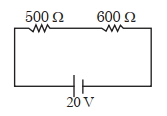
- 4Two resistors are connected in series across a battery as shown in figure. If a voltmeter of resistance $2000 \,\Omega$ is used to measure the potential difference across $500 \,\Omega$ resister, the reading of the voltmeter will be ............... $V$View Solution
- 5An unknown resistance $R_1$ is connected in series with a resistance of $10 \,\Omega$. This combinations is connected to one gap of a meter bridge while a resistance $R_2$ is connected in the other gap. The balance point is at $50\, cm$. Now, when the $10 \,\Omega$ resistance is removed the balance point shifts to $40\, cm$. The value of $R_1$ is (in $ohm$)View Solution
- 6View SolutionSpecific resistance of a conductor increases with
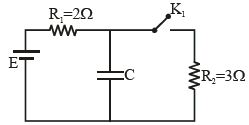
- 7In the circuit shown in the figure $K_1$ is open. The charge on capacitor $C$ in steady state is $q_1$. Now key is closed and at steady state charge on $C$ is $q_2$. The ratio of charges $q_1/q_2$ isView Solution
- 8View SolutionThermopile is used for
- 9If two wires having resistance $R$ and $2R$. Both joined in series and in parallel then ratio of heat generated in this situation, applying the same voltage,View Solution
- 10View SolutionFor the post office box arrangement to determine the value of unknown resistance the unknown resistance should be connected between