MCQ
On moving down a group of regular elements, both atomic and ionic radii increases with increasing
  • Atomic number
  • B
    Atomic weight
  • C
    Atomic mass
  • D
    None of these

Answer

Correct option: A.
Atomic number
a
On moving down the group, as atomic no. increases, atomic radii and ionic radii increases. As $e { }^{-}$s are added to new orbitals thereby increasing the radii.

Need a full question paper?

Generate a complete, print-ready paper with questions like this in minutes — across 16+ boards, with answer keys.

Start Generating Free

Similar questions

The product A formed in the following reaction is:
Image
Dilute aqueous $KMn{O_4}$, at room temperature reacts with ${\rm{ }}R - CH = CH - R$ to give
Given below are two statements :
Statement (I) : Kjeldahl method is applicable to estimate nitrogen in pyridine.
Statement (II) : The nitrogen present in pyridine can easily be converted into ammonium sulphate in Kjeldahl method.
In the light of the above statements, choose the correct answer from the options given below.
$(A)\xrightarrow[{\begin{array}{*{20}{c}}
  {(2){\kern 1pt} A{g_2}O/{H_2}O} \\ 
  {(3){\kern 1pt} \Delta } 
\end{array}}]{{(1){\kern 1pt} \,excess\,{\kern 1pt} C{H_3}I/{K_2}C{O_3}}}(B)$ $\xrightarrow[{(iii){\kern 1pt} \Delta }]{{\begin{array}{*{20}{c}}
  {(i){\kern 1pt} excess{\kern 1pt} C{H_3}I/{K_2}C{O_3}} \\ 
  {(ii){\kern 1pt} A{g_2}O} 
\end{array}}}$ $\begin{array}{*{20}{c}}
  {{H_2}C = CH - CH - CH = C{H_2}} \\ 
  {|{\mkern 1mu} {\mkern 1mu} {\mkern 1mu} {\mkern 1mu} {\mkern 1mu} } \,\,\,\,\\ 
  {{\mkern 1mu} {\mkern 1mu} C{H_3}} 
\end{array}$

Identify $A$

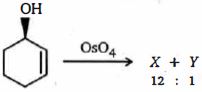
Product $(X)$ will be
Based on the equation

$\Delta E =  - 2.0 \times {10^{ - 18}}\,J\left( {\frac{1}{{n_2^2}} - \frac{1}{{n_1^2}}} \right)$ 

the wavelength of the light that must be absorbed to excite hydrogen electron from level $n\, = 1$ to level $n\, = 2$ will be: $(h\, = 6.625\times10^{-34}\, J\,s,\, C\, = 3\times10^8\, m\,s^{-1})$

The rate of disappearance of $S{O_2}$ in the reaction $2S{O_2} + {O_2} \to 2S{O_3}$ is $1.28 \times {10^{ - 3}}g/sec$ then the rate of formation of $S{O_3}$ is
The equilibrium constant for the reaction $Zn ( s )+ Sn ^{2+}( aq ) \rightleftharpoons Zn ^{2+}( aq )+ Sn ( s )$ is $1 \times 10^{20}$ at $298 K$. The magnitude of standard electrode potential of $Sn / Sn ^{2+}$ if $E _{ Zn ^{2+/ / nn }}^0=-0.76 V$ is $............\times 10^{-2}\,V$. (Nearest integer)

Given : $\frac{2.303 RT }{ F }=0.059\,V$

Which of the following is not an example of benzenoid compound?
$2-$ pentanone can be distinguished from $3-$ pentanone by the reagent