MCQ
On suddenly remove the tensile force on a wire, the temperature of the wire:
  • increases
  • B
    decreases
  • C
    remains unchanged
  • D
    not certain.

Answer

Correct option: A.
increases
A

Need a full question paper?

Generate a complete, print-ready paper with questions like this in minutes — across 16+ boards, with answer keys.

Start Generating Free

Similar questions

A particle is projected horizontally from a tower with velocity $10\,m / s$. Taking $g=10\,m / s ^2$. Match the following two columns at time $t=1\,s$.
Column $I$ Column $II$
$(A)$ Horizontal component of velocity $(p)$ $5$ SI unit
$(B)$ Vertical component of velocity $(q)$ $10$ SI unit
$(C)$ Horizontal displacement $(r)$ $15$ SI unit
$(D)$ Vertical displacement $(s)$ $20$ SI unit
Five gas molecules chosen at random are found to have speeds of $500,600,700,800$ and $900 m / s$. Then which of the following statements is correct?
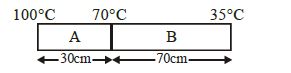
Two different rods $A$ and $B$ are kept as shown in figure. The ratio of thermal conductivities of $A$ and $B$ is
This question has statement $1$ and statement $2$ . Of the four choices given after the statements, choose the one that best describes the two statements. 
Statement $- 1$: A point particle of mass m moving with speed $u$ collides with stationary point particle of mass $M$. If the maximum energy loss possible is given as $f$ $\left( {\frac{1}{2}m{v^2}} \right)$ then $ f = \left( {\frac{m}{{M + m}}} \right)$ 

Statement $-2$: Maximum energy loss occurs when the particles get stuck together as a result of the collision.
A smooth sphere of mass $M$ moving with velocity $u$ directly collides elastically with another sphere of mass m at rest. After collision their final velocities are $V$ and $v$ respectively. The value of $v$ is
Which of the following is the example of ideal black body
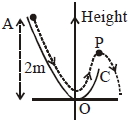
A particle $(\mathrm{m}=1\; \mathrm{kg})$ slides down a frictionless track $(AOC)$ starting from rest at a point $A$ (height $2\; \mathrm{m}$ ). After reaching $\mathrm{C}$, the particle continues to move freely in air as a projectile. When it reaching its highest point $P$ (height $1 \;\mathrm{m}$ ). the kinetic energy of the particle (in $\mathrm{J}$ ) is : (Figure drawn is schematic and not to scale; take $\left.g=10 \;\mathrm{ms}^{-2}\right)$
In a liquid flowing through a pipe, the pressure difference between its ends is made half and the radius is doubled. If the initial rate of flow of liquid was $Q$. What is the new rate of flow of liquid through the pipe?
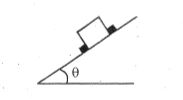
A railway line is taken round a circular arc of radius $1000\ m$ , and is banked by raising the outer rail $h$ $m$ above the inner rail. If the lateral force on the inner rail when a train travels round the curve at $10\ ms^{-1}$ is equal to the lateral force on the outer rail when the train's speed is $20\ ms^{-1}$ . The value of $4g\ tan\theta $ is equal to : (The distance between the rails is $1.5\ m$ )
The heat is flowing through a rod of length $50 cm$ and area of cross-section $5c{m^2}$. Its ends are respectively at ${25^o}C$ and ${125^o}C$. The coefficient of thermal conductivity of the material of the rod is $0.092 kcal/m×s×^\circ C$. The temperature gradient in the rod is