MCQ
This question has statement $1$ and statement $2$ . Of the four choices given after the statements, choose the one that best describes the two statements. 
Statement $- 1$: A point particle of mass m moving with speed $u$ collides with stationary point particle of mass $M$. If the maximum energy loss possible is given as $f$ $\left( {\frac{1}{2}m{v^2}} \right)$ then $ f = \left( {\frac{m}{{M + m}}} \right)$ 

Statement $-2$: Maximum energy loss occurs when the particles get stuck together as a result of the collision.

  • A
    Statement $-1$ is true, Statement $-2$ is true ;

    Statement $-2$ is the correct explanation of Statement $-1$

  • B
    Statement $-1$ is true, Statement $-2$ is true ;

    Statement $-2$ is not the correct explanation of Statement $-1$

  • Statement $-1$ is false, Statement $-2$ is true
  • D
    Statement $-1$ is true, Statement $-2$ is false
Answer

Correct option: C.
Statement $-1$ is false, Statement $-2$ is true
c
Maximum energy loss $=\frac{{{P^2}}}{{2m}} - \frac{{{P^2}}}{{2\left( {m + M} \right)}}$

$\left[ {\because \,K.E. = \frac{{{P^2}}}{{2m}} = \frac{1}{2}m{v^2}} \right]$

$ = \frac{{2{P^2}}}{{2m}}\left[ {\frac{M}{{\left( {m + M} \right)}}} \right] = \frac{1}{2}m{v^2}\left\{ {\frac{M}{{m + M}}} \right\}$

Statement II is a case of perfectly inelastic collision.By comparing the equation given in statement I with abpve equation, we get

$f = \left( {\frac{M}{{m + M}}} \right)\,instead\,of\,\left( {\frac{m}{{M + m}}} \right)$

Hence statement $I$ is wrong and statement $II$ is correct.

Need a full question paper?

Generate a complete, print-ready paper with questions like this in minutes — across 16+ boards, with answer keys.

Start Generating Free

Similar questions

If $C$ represents capacitance and $R$ represents resistance, then the unit of $\ce{CR^2}$ are:
$A.$ Henry
$B.$ Volt $-$ Second/ Ampere
$C.$ Volt/ ampere
$D.$ Joule/ampere$^2$
The efficiency of the heat engine:
Two uniform strings $A$ and $B$ made of steel are made to vibrate under the same tension. if the first overtone of $ A$ is equal to the second overtone of $B$ and if the radius of $A$ is twice that of $B,$ the ratio of the lengths of the strings is
A body of mass $5\ kg$ undergoes a change in speed from $30$ to $40\ m/ s.$ Its momentum would increase by:
Temperature can be expressed as a derived quantity in terms of any of the following
On a calm day, a boat can go across a lake and return in time $T_0$ at a speed $V$. On a rough day, there is uniform current at speed $v$ to help the onward journey and impede the return journey. If the time taken to go across and return on the rough day be $T$, then $T / T_0$ is
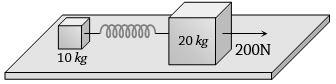
The masses of $10\, kg$ and $20 \,kg$ respectively are connected by a massless spring as shown in figure. A force of $200\, N$ acts on the $20\, kg$ mass. At the instant shown, the $10\, kg$ mass has acceleration $12\,m/{\sec ^2}$. What is the acceleration of $20\, kg$ mass ........... $m/{\sec ^2}$
Given below are two statements. One is labelled as Assertion $A$ and the other is labelled as Reason $R$.

Assertion A :Two identical balls $A$ and $B$ thrown with same velocity '$u$ ' at two different angles with horizontal attained the same range $R$. If $A$ and $B$ reached the maximum height $h_{1}$ and $h_{2}$ respectively, then $R =4 \sqrt{ h _{1} h _{2}}$

Reason R: Product of said heights.

$h _{1} h _{2}=\left(\frac{u^{2} \sin ^{2} \theta}{2 g }\right) \cdot\left(\frac{u^{2} \cos ^{2} \theta}{2 g }\right)$

Choose the $CORRECT$ answer 

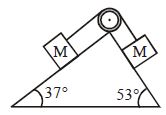
The acceleration of system of two bodies over the wedge as shown in the figure is ....... $m/sec^2$
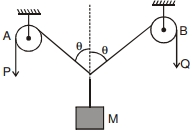
In the arrangement shown in fig. the ends $P$ and $Q$ of an unstretchable string move downwards with uniform speed $U$. Pulleys $A$ and $B$ are fixed. Mass $M$ moves upwards with a speed.