MCQ
On the interval $I = [- 2, 2]$, the function

$f(x) =$ $\left\{ {\begin{array}{*{20}{c}}   {(x\, + \,1)\,\,{e^{ - \,\left[ {\tfrac{1}{{|x|}}\,\, + \,\,\tfrac{1}{x}} \right]}}}&{(x\,\, \ne \,\,0)} \\    {0\,\,\,\,\,\,\,\,\,\,\,\,\,\,\,\,\,\,\,\,\,\,\,\,\,\,\,\,\,}&{(x\,\, = \,\,0)} \end{array}} \right.$

then which one of the following does not hold good ?

  • is continuous for all values of $x \in I$
  • B
    is continuous for $x \in I - (0)$
  • C
    assumes all intermediate values from $f(- 2) \& f(2)$
  • D
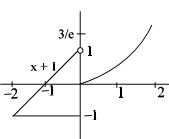
    has a maximum value equal to $3/e$ .

Answer

Correct option: A.
is continuous for all values of $x \in I$
a
$f (x) =$  $\left[ \begin{gathered}  (x + 1){e^{ - 2/x}}\,\,\,\,\,if\,\,\,x > 0 \hfill \\  x + 1\,\,\,\,\,\,\,\,\,\,\,\,\,\,\,\,\,\,\,\,if\,\,\,x\, < \,0 \hfill \\  0\,\,\,\,\,\,\,\,\,\,\,\,\,\,\,\,\,\,\,\,\,\,\,\,\,\,if\,\,\,\,x\, = \,0\, \hfill \\ \end{gathered}  \right.$

the graph of $f (x)$ is

hence $f$ can assume all values for $f (- 2) to f (2)$

Need a full question paper?

Generate a complete, print-ready paper with questions like this in minutes — across 16+ boards, with answer keys.

Start Generating Free

Similar questions

Let â be a unit vector perpendicular to the vectors $\overrightarrow{ b }=\hat{ i }-2 \hat{ j }+3 \hat{ k }$ and $\overrightarrow{ c }=2 \hat{ i }+3 \hat{ j }-\hat{ k }$, and makes an angle of $\cos ^{-1}\left(-\frac{1}{3}\right)$ with the vector $\hat{ i }+\hat{ j }+\hat{ k }$. If $\hat{ a }$ makes an angle of $\frac{\pi}{3}$ with the vector $\hat{ i }+\alpha \hat{ j }+\hat{ k }$, then the value of $\alpha$ is :
$ABC$ is an isosceles triangle . If the co-ordinates of the base are $(1, 3)$ and $(- 2, 7) $, then co-ordinates of vertex $A$ can be :
The inverse of $\left[ {\begin{array}{*{20}{c}}2&{ - 3}\\{ - 4}&2\end{array}} \right]$is
$S=\{(x, y, z): x, y, z \in Z, x+2 y+3 z=42$ $\mathrm{x}, \mathrm{y}, \mathrm{z} \geq 0\}$ ...........
Let  $f(x) =\left| {\begin{array}{*{20}{c}}
{\cos \,x}&{\sin \,x}&{\cos \,x}\\
{\cos \,2x}&{\sin \,2x}&{2\,\cos \,2x}\\
{\cos \,3x}&{\sin \,3x}&{3\,\cos \,3x}
\end{array}} \right| $then $f ' \left( {\frac{\pi }{2}} \right)$=
For the hyperbola $\frac{{{x^2}}}{9} - \frac{{{y^2}}}{3} = 1$  the incorrect statement is :
$\int_1^e {\frac{{1 + \log x}}{x}\,dx = } $
If $\alpha ,\beta $ are the roots of the equation $a{x^2} + bx + c = 0$ then the equation whose roots are $\alpha + \frac{1}{\beta }$ and $\beta + \frac{1}{\alpha }$, is
If $I_n =$ $\int\limits_0^1 {\,\,\frac{{dx}}{{{{\left( {1\,\, + \,\,{x^2}} \right)}^n}}}} $; $n \in N$, then which of the following statements hold good ?
The value of the integral $\int\limits_0^1 {x\,{{\cot }^{ - 1}}\,\left( {1 - {x^2} + {x^4}} \right)} dx$ is