Question
On what factors is induced current in a coil depends?

Answer

Induced current depends on: (i) Number of turns in the coil (ii) Resistance of the coil and (iii) Rate of change of flux in the coil.

Need a full question paper?

Generate a complete, print-ready paper with questions like this in minutes — across 16+ boards, with answer keys.
Start Generating Free

Similar questions

Can a solid conducting sphere of the same radius be charged more than a hollow sphere? Give the reason also.
If we walk barefoot on a nylon mat for some time and touch the metal handle of a door, we get an electric shock. Why does this happen?
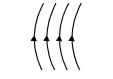
What type of electric field is shown by the lines in the figure?
Image
The dielectric constant decreases if the temperature is increased. Explain this in terms of polarization of the material.
A metal block of density 6000kg m-3 and mass 1.2kg is suspended through a spring of spring constant 200N m-1. The spring-block system is dipped in water kept in a vessel. The water has a mass of 260g and the block is at a height 40cm above the bottom of the vessel. If the support to the spring is broken, what will be the rise in the temperature of the water. Specific heat capacity of the block is 250Jkg-1 K-1 and that of water is 4200Jkg-1 K-1. Heat capacities of the vessel and the spring are negligible.
Define dispersion of colours.
Two equal balls having equal positive charge ‘q’ coulombs are suspended by two insulating strings of equal length. What would be the effect on the force when a plastic sheet is inserted between the two?
NaCl molecule is bound due to the electric force between the sodium and the chlorine ions when one electron. of sodium is transferred to chlorine. Taking the separation between the ions to be 2.75 × 10cm, find the force of attraction between them· State the assumptions (if any) that you have made.
Is it possible for a current loop to stay without rotating in a uniform magnetic field? If yes, what should be the orientation of the loop?
If on converting galvanometer of resistance G into ammeter, 1% of main current passes through the galvanometer, then what is the resistance of the shunt?