Question
One conducting sphere has 50e charge and the other identical sphere has + 20e charge. If both the sphere are touched and separated, then the charge on each will be:

Answer

(a)-15e

Need a full question paper?

Generate a complete, print-ready paper with questions like this in minutes — across 16+ boards, with answer keys.
Start Generating Free

Similar questions

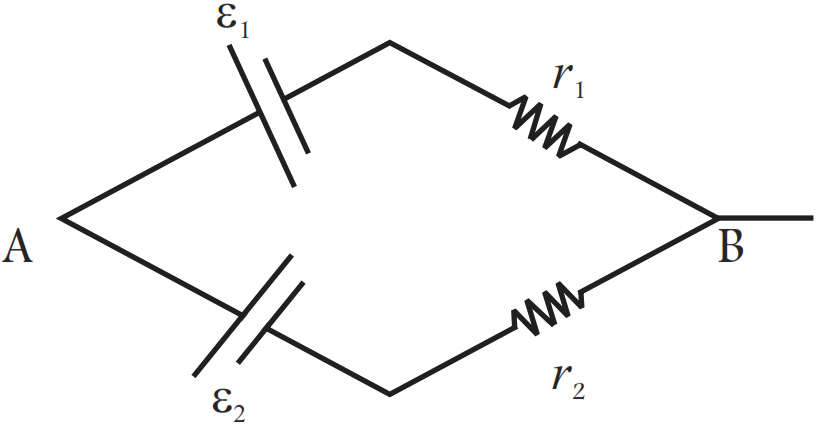
Two batteries of emf $\epsilon_1$ and $\epsilon_2(\epsilon_2>\epsilon_1)$ and internal resistances $r_1$ and $r_2$ respectively are connected in parallel as shown in Fig.
The value of red colour in colour code of carbon resistance :
Consider the following two statements.
  1. If heat is added to a system, its temperature must increase.
  2. If positive work is done by a system in a thermodynamic process, its volume must increase.
  1. Both A and B are correct.
  2. A is correct but B is wrong.
  3. B is correct but A is wrong.
  4. Both A and B are wrong.
Particles having positive charges occasionally come with high velocity from the sky towards the earth. On account of the magnetic field of earth, they would be deflected towards the(a) North   (b) South(c) East   (d) West
       
If a 0.1 % increase in length due to stretching, the percentage increase in its resistance will be(a) 0.2 %(b) 2 %(c) 1 %(d) 0.1 %
       
Consider an NPN transistor amplifier in common-emitter configuration. The current gain of the transistor is 100. If the collector current changes by 1 mA, what will be the change in emitter current(a) 1.1 mA(b) 1.01 mA (c) 0.01 mA(d) 10 mA
       
In Young's double slit experiment, the distance between the two slits is $0.1\ mm$ and the wavelength of light used is $4 \times 10^{-7} m$ . If the width of the fringe on the screen is $4\ mm,$ the distance between screen and slit is
The phenomenon utilised in an optical fibre is(a) Refraction(b) Interference(c) Polarization(d) Total internal reflection
   
   
Let $\overrightarrow{\text{E}}$ and $\overrightarrow{\text{B}}$ denote electric and magnetic fields in a frame S and $\overrightarrow{\text{E}}$ and $\overrightarrow{\text{B}}$ in another frame S moving with respect to S at a velocity $\overrightarrow{\text{v}}.$ Two of the following equations are wrong. Identify them.
  1. $\text{B}_\text{y},=\text{B}_\text{y}+\frac{\text{vE}_\text{z}}{\text{c}^2}$
  2. $\text{E}_\text{y},=\text{E}_\text{y}+\frac{\text{vB}_\text{z}}{\text{c}^2}$
  3. $\text{B}'_\text{y}=\text{B}_\text{y}+\text{v}\text{E}_\text{z}$
  4. $\text{E}'_\text{y}=\text{E}_\text{y}+\text{vB}_\text{z}$
The two bulbs as in the above question are connected in series to a 200 volt line. Then(a) The potential drop across the two bulbs is the same(b) The potential drop across the 40 watt bulb is greater than the potential drop across the 100 watt bulb(c) The potential drop across the 100 W bulb is greater than the potential drop across the 40 W bulb(d) The potential drop across both the bulb is 200 volt