One end of a long metallic wire of length $L$ is tied to the ceiling. The other end is tied to massless spring of spring constant $K$. A mass $ m$ hangs freely from the free end of the spring. The area of cross-section and Young's modulus of the wire are $A$ and $Y$ respectively. If the mass is slightly pulled down and released, it will oscillate with a time period $T$ equal to
IIT 1993, Diffcult
Download our app for free and get started
(b) The wire may be treated as a string for which force constant
${k_1} = \frac{{Force}}{{Extension}} = \frac{{YA}}{L}\;\;\;\left( {\because Y = \frac{F}{A} \times \frac{L}{{\Delta L}}} \right)$
Spring constant of the spring ${k_2} = K$
Hence spring constant of the combination (series) ${k_{eq}} = \frac{{{k_1}{k_2}}}{{{k_1} + {k_2}}} $
$= \frac{{(YA/L)K}}{{(YA/L) + K}}$
$= \frac{{YAK}}{{YA + KL}}$
Time period $T = 2\pi \sqrt {\frac{m}{k}} = 2\pi {\left[ {\frac{{(YA + KL)m}}{{YAK}}} \right]^{1/2}}$

Download our appand get started for free
Experience the future of education. Simply download our apps or reach out to us for more information. Let's shape the future of learning together!No signup needed.*
Similar Questions
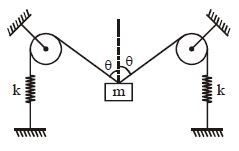
- 1View SolutionIn the situation as shown in figure time period of vertical oscillation of block for small displacements will be
- 2A particle of mass $10$ grams is executing simple harmonic motion with an amplitude of $0.5\, m$ and periodic time of $(\pi /5)$ seconds. The maximum value of the force acting on the particle is ... $N$View Solution
- 3A body executing $S.H.M.$ along a straightline has a velocity of $3 \,ms ^{-1}$ when it is at a distance of $4 \,m$ from its mean position and $4 \,ms ^{-1}$ when it is at a distance of $3 \,m$ from its mean position. Its angular frequency and amplitude areView Solution
- 4The frequency of oscillation of a mass $m$ suspended by a spring is $v_1$. If length of spring is cut to one third then the same mass oscillates with frequency $v_2$, thenView Solution
- 5A particle performing $SHM$ is found at its equilibrium at $t = 1\,sec$. and it is found to have a speed of $0.25\,m/s$ at $t = 2\,sec$. If the period of oscillation is $6\,sec$. Calculate amplitude of oscillationView Solution
- 6A block is placed on a frictionless horizontal table. The mass of the block is m and springs are attached on either side with force constants ${K_1}$ and ${K_2}$. If the block is displaced a little and left to oscillate, then the angular frequency of oscillation will beView Solution
- 7The general displacement of a simple harmonic oscillator is $x = A \sin \omega t$. Let $T$ be its time period. The slope of its potential energy (U) - time (t) curve will be maximum when $t=\frac{T}{\beta}$. The value of $\beta$ is $.........$View Solution
- 8If the time period of a two meter long simple pendulum is $2\, s$, the acceleration due to gravity at the place where pendulum is executing $S.H.M.$ isView Solution
- 9A simple pendulum is suspended in a car. The car starts moving on a horizontal road according to equation $x\, = \,\frac{g}{2}\,\sqrt 3 {t^2}$. Find the time period of oscillation of the pendulum.View Solution
- 10A body is vibrating in simple harmonic motion with an amplitude of $0.06\, m$ and frequency of $15\, Hz$. The velocity and acceleration of body isView Solution