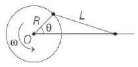
One end of a rod of length $L$ is fixed to a point on the circumference of a wheel of radius $R$. The other end is sliding freely along a straight channel passing through the centre of the wheel as shown in the figure below. The wheel is rotating with a constant angular velocity $\omega$ about $O$. Taking $T=\frac{2 \pi}{\omega}$, the motion of the rod is
KVPY 2017, Advanced


Download our appand get started for free
Experience the future of education. Simply download our apps or reach out to us for more information. Let's shape the future of learning together!No signup needed.*
Similar Questions
- 1A uniform cylinder of length $L$ and mass $M$ having cross-sectional area $A$ is suspended, with its length vertical, from a fixed point by a massless spring, such that it is half submerged in a liquid of density $\sigma $ at equilibrium position. When the cylinder is given a downward push and released, it starts oscillating vertically with a small amplitude. The time period $T$ of the oscillations of the cylinder will beView Solution
- 2For a periodic motion represented by the equation $Y=\sin \omega t+\cos \omega t$ The amplitude of the motion isView Solution
- 3A ring is suspended from a point $S$ on its rim as shown in the figure. When displaced from equilibrium, it oscillates with time period of $1\,second.$ The radius of the ring is ..... $m$ (take $g = \pi ^2$ )View Solution

- 4The length of the second pendulum on the surface of earth is $1\, m$. The length of seconds pendulum on the surface of moon, where g is 1/6th value of $g$ on the surface of earth, isView Solution
- 5Equations $y = 2A \cos ^2 \omega \,t$ and $y = A (\sin \omega t + \cos \omega t )$ represent the motion of two particles.View Solution
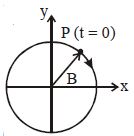
- 6A $3\ kg$ sphere dropped through air has a terminal speed of $25\ m/s$. (Assume that the drag force is $-bv$.) Now suppose the sphere is attached to a spring of force constant $k = 300\ N/m$, and that it oscillates with an initial amplitude of $20\ cm$. What is the angular frequencu of its damped $SHM$? ..... $rad/s$View Solution
- 7Starting from the mean position a body oscillates simple harmonically with a period of $2\,s.$ After what time will its kinetic energy be $75\%$ of the total energy ?View Solution
- 8Springs of spring constants $K, 2K, 4K, 8K,$ ..... are connected in series. A mass $40\, gm$ is attached to the lower end of last spring and the system is allowed to vibrate. What is the time period of oscillation ..... $\sec$. (Given $K = 2\, N/cm$)View Solution
- 9A mass $0.9\,kg$, attached to a horizontal spring, executes $SHM$ with an amplitude $A _{1}$. When this mass passes through its mean position, then a smaller mass of $124\,g$ is placed over it and both masses move together with amplitude $A _{2}$. If the ratio $\frac{ A _{1}}{ A _{2}}$ is $\frac{\alpha}{\alpha-1}$, then the value of $\alpha$ will be$......$View Solution
- 10Figure shows the circular motion of a particle. The radius of the circle, the period, sense of revolution and the initial position are indicated on the figure. The simple harmonic motion of the $x-$ projection of the radius vector of the rotating particle $P$ isView Solution