One-forth length of a spring of force constant $K$ is cut away. The force constant of the remaining spring will be
Medium
Download our app for free and get started
(b) By using $K \propto \frac{1}{l}$
Since one fourth length is cut away so remaining length is $\frac{3}{4}th$, hence $k$ becomes $\frac{4}{3}$ times i.e., $k' = \frac{4}{3}x$.
Since one fourth length is cut away so remaining length is $\frac{3}{4}th$, hence $k$ becomes $\frac{4}{3}$ times i.e., $k' = \frac{4}{3}x$.

Download our appand get started for free
Experience the future of education. Simply download our apps or reach out to us for more information. Let's shape the future of learning together!No signup needed.*
Similar Questions
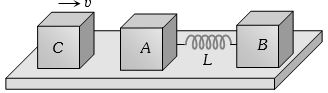
- 1Two blocks $A$ and $B$ each of mass m are connected by a massless spring of natural length L and spring constant $K$. The blocks are initially resting on a smooth horizontal floor with the spring at its natural length as shown in figure. A third identical block $C$ also of mass $m$ moves on the floor with a speed $v$ along the line joining $A$ and $B$ and collides with $A$. ThenView Solution
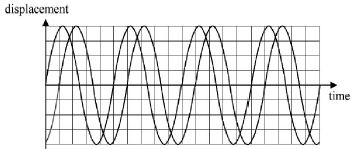
- 2The motion of a simple pendulum excuting $S.H.M$. is represented by following equation.View Solution
$Y = A \sin (\pi t +\phi)$, where time is measured in $second$.
The length of pendulum is .............$cm$
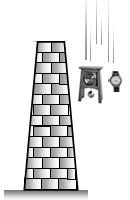
- 3A man having a wrist watch and a pendulum clock rises on a $TV$ tower. The wrist watch and pendulum clock per chance fall from the top of the tower. ThenView Solution
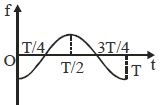
- 4A body is performing simple harmonic motion with amplitude a and time period $T$. Variation of its acceleration $(f)$ with time $(t)$ is shown in figure. If at time $t$, velocity of the body is $v$, which of the following graphs is correctView Solution
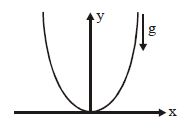
- 5A particle of mass $5 × 10^{-5}\ kg$ is placed at lowest point of smooth parabola $x^2 = 40y$ ( $x$ and $y$ in $m$ ). If it is displaced slightly such that it is constrained to move along parabola, angular frequency of oscillation (in $rad/s$) will be approximately:-View Solution
- 6View SolutionIn forced oscillations, a particle oscillates simple harmonically with frequency equal to
- 7When an oscillator completes $100$ oscillations its amplitude reduced to $\frac{1}{3}$ of initial value. What will be its amplitude, when it completes $200$ oscillations?View Solution
- 8The particle executing simple harmonic motion has a kinetic energy $K_0cos^2 \omega t$. The maximum values of the potential energy and the total energy are respectivelyView Solution
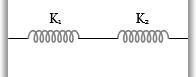
- 9View SolutionThe effective spring constant of two spring system as shown in figure will be
- 10View SolutionThe diagram shows two oscillations. What is the phase difference between the oscillations?