Question
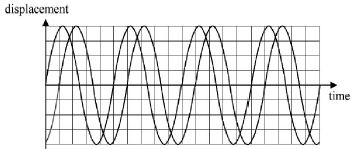
The diagram shows two oscillations. What is the phase difference between the oscillations?
Answer

Get the step-by-step solution for this question inside the Vidyadip app.

Get the answer in the app

Need a full question paper?

Generate a complete, print-ready paper with questions like this in minutes — across 16+ boards, with answer keys.
Start Generating Free

Similar questions

Two beams, $A$ and $B$, of plane polarized light with mutually perpendicular planes of polarization are seen through a polaroid. From the position when the beam $A$ has maximum intensity ( and beam $B$ has zero intensity), a rotation of polaroid through $30 ^o $ makes the two beams appear equally bright. If the initial intensities of the two beams are $I_A$ and $I_B$  respectively, then $\frac{{{I_A}}}{{{I_B}}}$=
At a particular instant the current in the circuit given below is $i$. The displacement current between the plates of the capacitor shown below is ..........
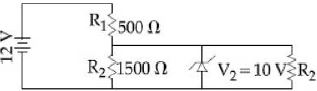
In the given circuit the current through Zener Diode is close to.......$mA$
A block of mass $m$ (initially at rest) is sliding up (in vertical direction) against a rough vertical wall with the help of a force $F$ whose magnitude is constant but direction is changing. $\theta  = {\theta _0}t$  where $t$ is time in sec. At $t$ = $0$ , the force is in vertical upward direction and then as time passes its direction is getting along normal, i.e., $\theta  = \frac{\pi }{2}$ .The value of $F$ so that the block comes to rest when $\theta  = \frac{\pi }{2}$ , is 
When unit mass of water boils to become steam at $100\,^0C$, it absorbs $Q$ amount of heat. The densities of water and steam at $100\,^0C$ are $\rho_1$ and $\rho_2$ respectively and the atmospheric pressure is $p_0$. The increase in internal energy of the water is 
A $6\,\mu F$ capacitor is charged from $10\;volts$ to $20\;volts$. Increase in energy will be
Which of the following is different from others
Frequency of the $K\alpha$  $X$-ray for the element calcium $(Ca, Z = 20)$ is $8.95 × 10^{17} \ Hz$ Frequency of $K\alpha$  $X-$ray for element cadmium $(Cd, Z = 48)$ will be
In the determination of Young's modulus $\left(Y=\frac{4 MLg }{\pi / d ^2}\right)$ by using Searle's method, a wire of length $L=2 \ m$ and diameter $d =0.5 \ mm$ is used. For a load $M =2.5 \ kg$, an extension $\ell=0.25 \ mm$ in the length of the wire is observed. Quantities $d$ and $\ell$ are measured using a screw gauge and a micrometer, respectively. They have the same pitch of $0.5 \ mm$. The number of divisions on their circular scale is $100$ . The contributions to the maximum probable error of the $Y$ measurement
Calculate the current in wire $BD$ ................ $A$