MCQ
One Mach number is equal to
  • A
    Velocity of light
  • Velocity of sound $(332\,\,m/\sec )$
  • C
    $1\,\,km/\sec $
  • D
    $1\,m/\sec $

Answer

Correct option: B.
Velocity of sound $(332\,\,m/\sec )$
b
(b) Mach number $ = \frac{{{\rm{Velocity\, of\, object}}}}{{{\rm{Velocity \,of \,sound}}}}$.

Need a full question paper?

Generate a complete, print-ready paper with questions like this in minutes — across 16+ boards, with answer keys.

Start Generating Free

Similar questions

An $npn$ transistor operates as a common emitter amplifier, with a power gain of $60\, dB$. The input circuit resistance Is $100\,\Omega $ and the output load resistance is $10 \,k\,\Omega $. the common emitter current gain $\beta $ is
One car moving on a straight road covers one third of the distance with $20 \,km/hr $ and the rest with $60\, km/hr$. The average speed is..........$km/hr$
A conductor behaves as a superconductor
Maximum useable frequency $(MUF)$ in $F$ -region layer is $x$ , when the critical frequency is $60 \,MHz$ and the angle of incidence is $70°$. Then $x$ is.......$MHz$
A spring with spring constant k when stretched through $1\, cm$, the potential energy is $U$. If it is stretched by $4 \,cm.$ The potential energy will be
The colour of a star is an indication of its
Which one of the following statements is true
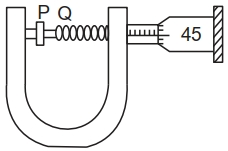
In an experiment to find out the diameter of wire using screw gauge, the following observation were noted.

$(a)$ Screw moves $0.5\,mm$ on main scale in one complete rotation

$(b)$ Total divisions on circular scale $=50$

$(c)$ Main scale reading is $2.5\,mm$

$(d)$ $45^{\text {th }}$ division of circular scale is in the pitch line

$(e)$ Instrument has $0.03 \;mm$ negative error

Then the diameter of wire is $...........\,mm$
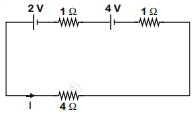
For the circuit shown in the figure, the current $I$ will be .......$A$
A particle is projected vertically upwards with a speed of $16\  m/s$ , after some time , when it again passes through the point of projection, its speed is found to be $8\  m/s$ . It is known that the work done by air resistance is same during upward and downward motion. Then the maximum height attained by the particle is ...................... $\mathrm{m}$ ( $g$ = $10\  m/s^2$ )