Question

One metallic sphere A is given positive charge whereas another identical metallic sphere B of exactly same mass as of  A is given equal amount of negative charge. Then

(a) Mass of  A and mass of  B still remain equal

(b) Mass of  A increases

(c) Mass of  B decreases

(d) Mass of  B increases

Answer

(d) Mass of  B increases

Need a full question paper?

Generate a complete, print-ready paper with questions like this in minutes — across 16+ boards, with answer keys.

Start Generating Free

Similar questions

The dimension of (1/2)  : permittivity of free space; E : electric field) is

(a)  

(b)  

(c)  

(d)  

Give the SI unit of magnetic dipole moment.

Assertion  :   Magnetism is relativistic.

Reason      : When we move along with the charge so that there is no motion relative to us, we find no magnetic field associated with the charge.

(a) If both assertion and reason are true and the reason is the correct explanation of the assertion.

(b) If both assertion and reason are true but reason is not the correct explanation of the assertion.

(c) If assertion is true but reason is false.

(d) If the assertion and reason both are false.

A 40 mF capacitor in a defibrillator is charged to 3000 V. The energy stored in the capacitor is sent through the patient during a pulse of duration 2ms. The power delivered to the patient is

(a) 45 kW

(b) 90 kW

(c) 180 kW

(d) 360 kW

5 cm long solenoid having 10 ohm resistance and 5 mH inductance is joined to a 10 volt battery. At steady state the current through the solenoid in ampere will be

(a) 5

(b) 1

(c) 2

(d) Zero

The energy gap in glass at room temperature is:
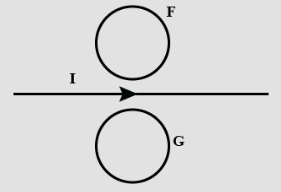
Two conducting circular loops F and G are kept in a plane on either side of a straight current-carrying wire as shown in the figure below. If the current in the wire decreases in magnitude, the induced current in the loops will be.

If the energy released in the fission of one nucleus is 200 MeV. Then the number of nuclei required per second in a power plant of 16 kW will be

(a) 0.5  

(b) 0.5  

(c) 5  

(d) 5  

Photoelectric effect proves that light wave :
An electron revolves around the nucleus of hydrogen atom in a circle of radius 5 × 10-11 m. The intensity of electric field at a point in the orbit of the electron is: