MCQ
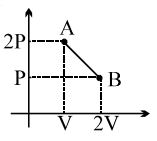
One mole of a gas expands obeying the relation as shown in the $P/V$ diagram. The maximum temperature in this process is equal to
  • A
    $\frac{{{P_0}{V_0}}}{R}$
  • B
    $\frac{{3{P_0}{V_0}}}{R}$
  • $\frac{{9{P_0}{V_0}}}{{8R}}$
  • D
    None of these

Answer

Correct option: C.
$\frac{{9{P_0}{V_0}}}{{8R}}$
c
This question can be solved by maxima

and minima.

since the graph shown here is a straight line, we can write it's equation in the form of $:$

$y=m x+c$

here $y=P, x=V, m=\frac{P_{2}-P_{1}}{V_{2}-V_{1}}=\frac{\frac{P_{0}}{2}-P_{0}}{2 V_{0}-V_{0}}$

$\Rightarrow m=\frac{-P_{0}}{2 V_{0}}$

$c$ is the intercept and $c=\frac{3 P_{0}}{2}$

We can find $c$ by extra polating the graph Now

$P=\frac{-P_{0}}{2 V_{0}} V+\frac{3 P_{0}}{2}$        $...(1)$

Also, from equation of state, we know the $P V=n R T$

for $1$ mole $P V=R T$

or $P=\frac{R T}{V}$

substituting this in equation $( 1)$

$\frac{R T}{V}=\frac{-P_{0}}{2 V_{0}} V+\frac{3 P_{0}}{2}$

$T=\frac{-\bar{P}_{0}}{2 R V_{0}} \cdot V^{2}+\frac{3 P_{0}}{2 R} V$

To find the minimum temperature, we will differentiate the above equation

i.e., $\frac{d T}{d V}=-\frac{2 P_{0}}{2 R V_{0}} \cdot V+\frac{3 P_{0}}{2 R}$

for $\frac{d T}{d V}=0 \Rightarrow \frac{P_{0}}{R V_{0}} \cdot V=\frac{3 P_{0}}{2 R}$

$\Rightarrow V=\frac{3 V_{0}}{2}$

This is the critical point.

$\frac{d^{2} T}{d V^{2}}=-\frac{P_{0}}{R V_{0}}$

which is negative since pressure and volume can't be negative.

$\Rightarrow$ pt of maximum

Now at $V=\frac{3 V_{0}}{2}$

maximum temperature $=T_{\max }=\frac{-P_{0}}{2 R V_{0}} \frac{9 V_{0}^{2}}{4}+\frac{3 P_{0}}{2 R} \cdot \frac{3 V_{0}}{2}$

$\Rightarrow T_{\max }=\frac{9 P_{0} V_{0}}{8 R}$

Need a full question paper?

Generate a complete, print-ready paper with questions like this in minutes — across 16+ boards, with answer keys.

Start Generating Free

Similar questions

A body rotating with uniform angular acceleration covers $100 \pi$ (radian) in the first $5 \,s$ after the start. Its angular speed at the end of $5 \,s$ (in radian/s) is .........$\pi$
At a certain temperature, the $r.m.s.$ velocity for ${O_2}$ is $400\, m/sec.$ At the same temperature, the $r.m.s.$ velocity for ${H_2}$ molecules will be ....... $m/sec$
An aeroplane is flying in a horizontal direction at $600\ km/ hr$ at a height of $6\ kms$ and is advancing towards a point which is exactly over a target on earth. At that instant the pilot releases a ball which on descending the earth strike the target. The falling ball appears$-$
A body is projected at an angle $\theta $ with horizontal, another body is projected with the same speed at an angle $\theta $ with the vertical then the ratio of the maximum height is
The electric field and the electric potential at a point are E and V respectively.
A uniform rod of mass $m$ and length $l$ is moving with velocity $u$ in a direction  perpendicular to its length. A blow of impulse $J$ is given perpendicular to its length at a distance $\frac{l}{4}$ from its centre at point $P$ such that instantaneous velocity of point $P$ is $2u$. Then the velocity of its centre of mass will be.
A $NCC$ parade is going at a uniform speed of $9\,km / h$ under a mango tree on which a monkey is sitting at a height of $19.6\,m$. At any particular instant, the monkey drops a mango. A cadet will receive the mango whose distance from the tree at time of drop is $...m$

(Given $g=9.8\,m / s ^{2}$ )

An athlete completes one round of a circular track of radius $10\, m$ in $40\, sec$. The distance covered by him in $2 \,min$ $20 \,sec$ is ........ $m$
A cane filled with water is revolved in a vertical circle of radius $4 $ meter and the water just does not fall down. The time period of revolution will be ........ $\sec$
A homogeneous cubical brick lies motionless on a rough inclined surface. The half of the brick which applies greater pressure on the plane is :