MCQ
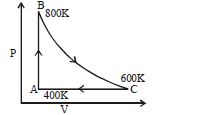
One mole of diatomic ideal gas undergoes a cyclic process $ABC$ as shown in figure. The process $BC$ is adiabatic. The temperatures at $A, B$ and $C$ are $400\,K, 800\,K$ and $600\,K$ respectively. Choose the correct statement
  • A
    The change in internal energy in the process $AB$ is $-350\,R$
  • The change in internal energy in the process $BC$ is $-500\,R$
  • C
    The change in internal energy in whole cyclic process is $250\,R$
  • D
    The change in internal energy in the process $CA$ is $700\,R$
Answer

Correct option: B.
The change in internal energy in the process $BC$ is $-500\,R$
b
For a diatomic gas,

$C_{v}=\frac{5}{2} R$

$\Delta U_{B A}=n C_{V}\left(T_{B}-T_{A}\right)=1 \times \frac{5 R}{2}(800-400)=1000 R$

$\Delta U_{A C}=\Delta Q_{A C}-W_{A C}=n C_{P}\left(T_{A}-T_{C}\right)-n R\left(T_{A}-T_{C}\right)=n C_{V}\left(T_{A}-T_{C}\right)=1 \times$

$\frac{5 R}{2}(400-600)=-500 R$

Thus, adding up the change in internal energy in both these processes, we get change in internal energy from $\mathrm{C}$ to $\mathrm{B}$ as $500 \mathrm{R}$.

As the change in internal energy is a point function we get $U_{B C}=-500 R$

Need a full question paper?

Generate a complete, print-ready paper with questions like this in minutes — across 16+ boards, with answer keys.

Start Generating Free

Similar questions

Gravitational acceleration on the surface of a planet is $\frac{\sqrt{6}}{11} \mathrm{~g}$, where $\mathrm{g}$ is the gravitational acceleration on the surface of the earth. The average mass density of the planet is $\frac{2}{3}$ times that of the earth. If the escape speed on the surface of the earth is taken to be $11 \ \mathrm{kms}^{-1}$, the escape speed on the surface of the planet in $\mathrm{kms}^{-1}$ will be
A particle of mass m is attached to a spring (of spring constant k) and has a natural angular frequency ${\omega _0}$ - An external force $F (t)$ proportional to $\cos \omega \,t((\omega \ne {\omega _0})$ is applied to the oscillator. The time displacement of the oscillator will be proportional to
The kinetic energy of the satellite in a circular orbit with speed vis given as:
Which thermodynamic property has the same value in systems when they are in thermal equilibrium?
An ideal gas of mass $m$ in a state $A$ goes to another state $B$ via three different processes as shown in figure. If $Q_{1}, Q_{2}$ and $Q_{3}$ denote the heat absorbed by the gas along the three paths, then
A tennis ball is released from height $h $ above ground level. If the ball makes inelastic collision with the ground, to what height will it rise after third collision
The measured value of the length of a simple pendulum is $20 \mathrm{~cm}$ with $2 \mathrm{~mm}$ accuracy. The time for $50$ oscillations was measured to be $40$ seconds with $1$ second resolution. From these measurements, the accuracy in the measurement of acceleration due to gravity is $\mathrm{N} \%$. The value of $\mathrm{N}$ is:
The radius of circle the period of revolution initial position and sense of revolution are indicated in the figure.

$y-$projection of the radius vector of rotating particle $\mathrm{P}$ is

For frictionless surfaces in given arrangement tension $T_2$ is :-
For a thermodynamic process $\delta Q = -50$ $calorie$ and $W = -20$ $calorie$ . If the initial internal energy is $-30$ $calorie$ then final internal energy will be ....... $calorie$