MCQ
One nanometre is equal to
  • A
    ${10^9}mm$
  • B
    ${10^{ - 6}}\,cm$
  • ${10^{ - 7}}cm$
  • D
    ${10^{ - 9}}cm$

Answer

Correct option: C.
${10^{ - 7}}cm$
c
(c) $1\,\,nm = {10^{ - 9}}m = {10^{ - 7}}cm$

Need a full question paper?

Generate a complete, print-ready paper with questions like this in minutes — across 16+ boards, with answer keys.
Start Generating Free

Similar questions

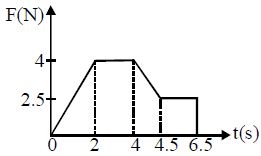
A body old $2\ kg$ has an initial speed $5\ ms^{-1}$ . A force acts on it for some time in the direction of motion. The force time graph is shown in figure. The final speed of the body .......... $ms^{-1}$
If the temperature of a uniform rod is slightly increased by $\Delta\text{t}$, its moment of inertia I about a perpendicular bisector increases by:
If a vector $\overrightarrow P $ making angles $\alpha, \beta\  and\ \gamma$ respectively with the $X, Y$ and $Z$ axes respectively. Then ${\sin ^2}\alpha + {\sin ^2}\beta + {\sin ^2}\gamma = $
The area of the triangle formed by $2\hat i + \hat j - \hat k$ and $\hat i + \hat j + \hat k$ is
A $1\, kg$ stone at the end of $1\, m$ long string is whirled in a vertical circle at constant speed of $4\, m/s$. The tension in the string is $6\, N$ when the stone is at $(g = 10\, m/s^2)$
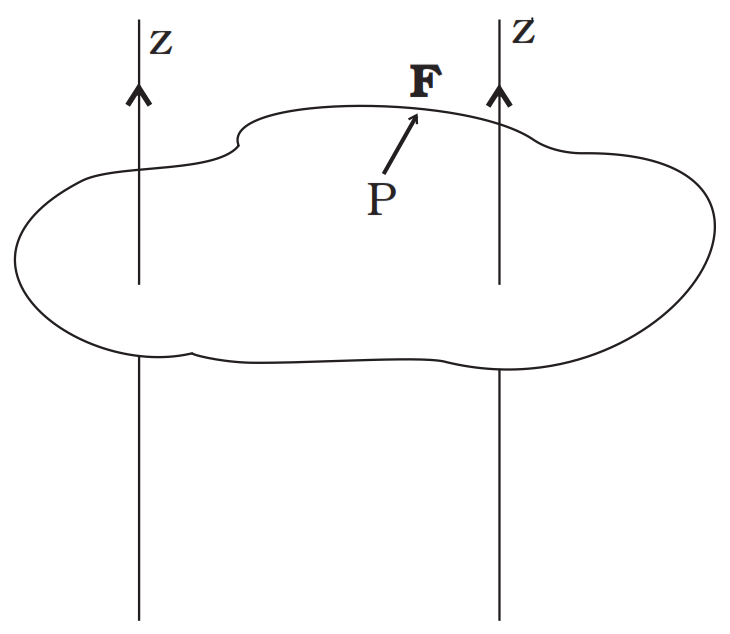
Shows a lamina in $x-y$ plane. Two axes $z$ and $z′$ pass perpendicular to its plane. A force $F$ acts in the plane of lamina at point $P$ as shown. Which of the following are true? $($The point $P$ is closer to $z′-$axis than the $z-$axis$)$
An aeroplane moving horizontally with a speed of $180\, km/hr$. drops a food packet while flying at a height of $490\,m$. The horizontal range is........$m$
Two moles of a monoatomic ideal gas is confined in a container and is heated such that its temperature increases by $10\,^oC$. The approximate change in its internal energy is  ..... $J$. $(R = 8.31\, J/mole-K)$
Sound waves of wavelength $\lambda$ travelling in a medium with a speed of $v m / s$ enter into another medium where its speed is $2 v m / s$. The wavelength of sound waves in the second medium is
Fountains usually seen in gardens are generated by a wide pipe with an enclosure at one end having many small holes. Consider one such fountain which is produced by a pipe of internal diameter $2$ $cm$ in which water flows at a rate $3$ $ms^{^{-1}}$. The enclosure has $100$ holes each of diameter $0.05$ $cm$. The velocity of water coming out of the holes ids ( in $ms^{^{-1}}$)