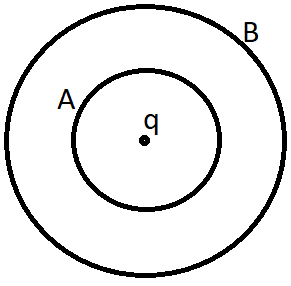
MCQ
One Volt is equal to:
- A1 Joule
- B1 Newton/ Coulomb
- C1 Joule/ Coulomb
- D1 Coulomb/ Newton
Explanation:
The volt is a measure of electric potential. One volt is defined as the difference in electric potential between two points of a conducting wire when an electric current of one ampere dissipates one watt of power between those points. It is also equal to the potential difference between two parallel, infinite planes spaced 1 meter apart that create an electric field of 1 newton per coulomb. Additionally, it is the potential difference between two points that will impart one joule of energy per coulomb of charge that passes through it. It can be expressed in terms of SI base units (m, kg, s, and A)
$1\text{volte}=\frac{1\text{joule}}{\text{Coulomb}}$
Generate a complete, print-ready paper with questions like this in minutes — across 16+ boards, with answer keys.
If the ratio of amplitude of two waves is 4 : 3, then the ratio of maximum and minimum intensity is
|
(a) 16 : 18 |
(b) 18 : 16 |
(c) 49 : 1 |
(d) 94 : 1 |
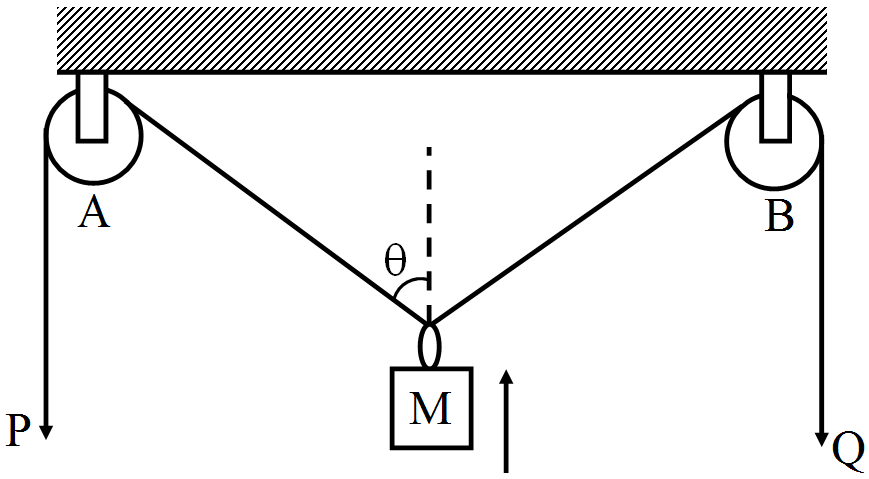
$2\text{u}\cos\theta$
$\frac{\text{u}}{\cos\theta}$
$\frac{\text{2u}}{\cos\theta}$
$\text{u}\cos\theta$
A circular current carrying coil has a radius R. The distance from the centre of the coil on the axis where the magnetic induction will be  to its value at the centre of the coil, is
|
(a) |
(b) R |
(c) 2 |
(d) |
Half life of a radioactive element is 10 days. The time during which quantity remains 1/10 of initial mass will be
|
(a) 100 days |
(b) 50 days |
(c) 33 days |
(d) 16 days |