MCQ
Only two isomers of monochloro product is possible of
  • $n-$butane
  • B
    $2,4-$dimethyl pentane
  • C
    Benzene
  • D
    $1-$methyl propane

Answer

Correct option: A.
$n-$butane
a
Hence, only $n$-Butane has two isomeric monochloro derivatives.

Need a full question paper?

Generate a complete, print-ready paper with questions like this in minutes — across 16+ boards, with answer keys.

Start Generating Free

Similar questions

$KI$ is oxidised into $I_2$ by using the reagent
$1.12\, ml$ of a gas is produced at $STP$ by the action of $4.12\, mg$ of alcohol, with methyl magnesium iodide. The molecular mass of alcohol is
Assertion : An orbital designated by $n = 3, l = 1$ has double dumb-bell shape.
Reason : It belongs to $p-$ subshell.
Which of the following have maximum number of atoms?
Which of the following possess two lone pair of electerons on the cental atom and square planar in shape ?

$(I)\, SP_4 \,\,\,(II)\, XeO_4 \,\,\,(Ill) \,XeF_4 \,\,\,(IV)\, ICl^-_4$

The $IUPAC$ name of $\begin{matrix}
   \,\,\,\,\,\,\,C{{H}_{2}}Cl  \\
   |\,\,\,  \\
   C{{H}_{2}}-CH-C{{H}_{2}}  \\
   |\,\,\,\,\,\,\,\,\,\,\,\,\,\,\,\,\,\,\,\,\,\,\,\,\,\,\,\,\,\,\,\,\,|\,\,\,\,\,\,  \\
   Cl\,\,\,\,\,\,\,\,\,\,\,\,\,\,\,\,\,\,\,\,\,\,\,\,\,\,\,\,\,Cl\,\,\,\,\,  \\
\end{matrix}$ is
A mixture of $100\, m\, mol$ of $Ca(OH)_2$ and $2\, g$ of sodium sulphate was dissolved in water and the volume was made upto $100\, mL$. The mass of calcium sulphate formed and the concentration of $OH^-$ in resulting solution, respectively are 

(Molar mass of $Ca(OH)_2, Na_2SO_4$ and $CaSO_4$ are $74, 143$ and $136\, g\, mol^{-1}$ respectively; $K_{sp}$ of $Ca(OH)_2$ is $5.5 \times 10^{-6}$)
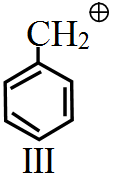
The order if stability of carbocations is :
$\text{CH}_2=\text{CH}-\text{CH}^{\oplus}_2\\ \ \ \ \ \ \ \ \ \ \ \ \ \ \ \ \text{I}$
$\text{CH}_3-\text{CH}_2-\text{CH}^{\oplus}_2\\ \ \ \ \ \ \ \ \ \ \ \ \ \ \ \ \text{II}$
Which of the following is most reactive for nucleophilic substitution reaction ?
What is the ratio of glyoxal to pyrualdehyde obtained in the above reaction ?

(figure) $\xrightarrow[{(2)\,Zn}]{{(1)\,{O_3}}}\mathop {\begin{array}{*{20}{c}}
  {\,\,\,\,O\,\,\,\,\,\,\,O\,\,} \\ 
  {\,||\,\,\,\,\,\,\,\,\,||} \\ 
  {H - C - C - H} 
\end{array}}\limits_{Glyoxal}  + $ $\mathop {\begin{array}{*{20}{c}}
  {\,\,\,O\,\,\,\,\,O\,\,} \\ 
  {\,||\,\,\,\,\,\,\,\,||} \\ 
  {C{H_3} - C - C - C{H_3}} 
\end{array}}\limits_{2,3 - Bu\tan edione}  + \mathop {\begin{array}{*{20}{c}}
  {\,\,\,\,\,\,O\,\,\,\,\,O} \\ 
  {\,\,\,\,\,\,||\,\,\,\,\,\,||} \\ 
  {C{H_3} - C - C - H} 
\end{array}}\limits_{Pyrualdehyde} $