Question
Outline the functioning of kidney dialysis machine?

Answer

A dialysis machine tries to mimic some of the functions of a human kidney. One of the primary work of a kidney is to remove urea and certain salts from the blood so they can exit the body in urine.
In a dialysis machine, blood from the patient runs through tubes made of a semi-porous membrane. Outside the tubes is a sterile solution made up of water, sugars and other components. Red and white blood cells and other important blood components are too large to fit through the pores in the membranes, but urea and salt flow through membranes into the sterile solution. The blood is passed along the tubes placed in dialyzing fluid that filter waste products from the blood through diffusion. The filtered blood is transported back into the body.

Need a full question paper?

Generate a complete, print-ready paper with questions like this in minutes — across 16+ boards, with answer keys.
Start Generating Free

Similar questions

Compare the properties of ionic compounds and covalent compounds.
The organs A of a person have been damaged completely due to which too much of a poisonous waste material B has started accumulating in his blood, making it dirty. In order to save this person's life, the blood from an artery in the person's arm is made to flow into long tubes made of substance E which are kept in coiled form in a tank containing solution F. This solution contains three materials G, H and I in similar proportions to those in normal blood. As the person's blood passes through long tubes of substance E, most of the wastes present in it go into solution. The clean blood is then put back into a vein in the arm of the person for circulation.
  1. What are organs A?
  2. Name the waste substance B.
  3. What are (i) E and (ii) F? Name G, H and I.
  4. What is the process described above known as?
The human body has an organ A which acts as a double pump. The oxygenated blood coming from the lungs through a blood vessel B enters the upper left chamber C of the double pump. When chamber C contracts, then blood goes into lower left chamber D. The contraction of chamber D forces the blood to go into a blood vessel E which supplies oxygenated blood to all the organs of the body (except the lungs). The deoxygenated blood coming out of the body organs is taken by a blood vessel F to the right upper chamber G of pumping organ. Contraction of chamber G forces the deoxygenated blood into right lower chamber H. And finally the contraction of chamber H sends the deoxygenated blood into lungs through a blood vessel I.
  1. What is organ A?
  2. Name the blood vessel (i) B (ii) E (iii) F, and (iv) I.
  3. What are chambers (i) C, and (ii) D?
  4. What are chambers (i) G and (ii) H?
There are four organisms A, B, C and D. The organism A eats only the flesh of other animals as food. The organism B can eat grains, fruits and vegetables as well as meat and fish. The organism C can make the food itself from simple inorganic substances present in the environment by utilising sunlight energy. On the other hand, organism D eats only plants and their products as food.
  1. Which organism is
  1. Omnivore,
  2. Herbivore,
  3. Carnivore?
  1. Which organism is an autotroph?
  2. Which organism is/ are heterotroph (s)?
  3. Which organism can be a producer?
  4. Which organism is/ are consumer (s)?
Give one example each of organisms which could be like A, B, C and D.
Write the chemical formula and name of the compound which is the active ingredient of all alcoholic drinks. List its two uses. Write chemical equation and name of the product formed when this compound reacts with-
  1. Sodium metal.
  2. Hot concentrated sulphuric acid.
What are fossils? How are they formed? Describe in brief two methods of determining the age of fossils. State any one role of fossils in the study of the process of evolution.
Give a detailed explanation on the following.Properties of acetic acid.
Write a few steps to reduce consumption of coal and petroleum.
State the functions of the following hormones:
  1. Thyroxine.
  2. Adrenaline.
  3. Growth hormone.

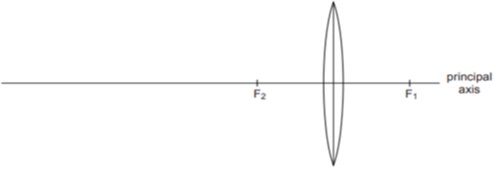
Image
The above image shows a thin lens of focal length $5 m$.
(i) What is the kind of lens shown in the above figure?
(ii) If a real inverted image is to be formed by this lens at a distance of $7 m$ from the pole, then show with calculation where should the object be placed?
(iii) Draw a neatly labelled diagram of the image formation mentioned in (ii)