Question
Write a few steps to reduce consumption of coal and petroleum.

Answer

The steps which can be taken to conserve coal and petroleum are:
  1. Use stairs to climb instead of taking a lift. This will save electricity.
  2. Pressure cookers should be used for cooking food to save fuels like kerosene and LPG.
  3. Renewable fuels like cooking gas (LPG) and CNG should be used.
  4. Solar machines like solar cookers, solar panel, solar water heaters should be used whenever possible.
  5. The use of biogas as domestic fuel should be encouraged.
  6. Use electrical appliances which takes less energy to save electricity.
  7. Bicycles should be used for covering short distances to save fuel.
  8. Switch off the lights, fans, television and other electrical appliances when not needed. This will save a lot of electricity.
  9. People should travel in public transport system (local bus and train service) instead of taking private cars.
  10. Engines of vehicles should be designed to reduce the consumption of petrol and diesel.

Need a full question paper?

Generate a complete, print-ready paper with questions like this in minutes — across 16+ boards, with answer keys.
Start Generating Free

Similar questions

With the help of a labelled circuit diagram illustrate the pattern of field lines of the magnetic field around a current carrying straight long conducting wire. How is the right hand thumb rule useful to find direction of magnetic field associated with a current carrying conductor?
The chemical substance P is made and secreted by the meristematic tissue at the tip of stem (or shoot) of a plant. The chemical substance P is responsible for a phenomenon Q in plants in which the stem bends towards a source of light. The same chemical substance P has an opposite effect on the root of a plant. It causes the root of a plant to bend away from the source of light in a process called R.
  1. What is the chemical substance P?
  2. State whether P prefers to remains in the sunlit side of a stem or in shade.
  3. What is the effect of substance P on the rate of growth of (i) a root, and (ii) a stem?
  4. What is the name of process (i) Q, and (ii) R?
  5. What is the general name of chemical substances like P? Name another substance which belongs to this class of chemical substances.
A potted plant is growing in a transparent glass jar. In this plant, X and Y are the two growing parts having a lot of meristematic tissue. It is observed that the part X of this plant exhibits positive geotropism but negative phototropism. On the other hand, part Y of this plant exhibits negative geotropism but positive phototropism.
  1. Name the part X of plant.
  2. Name the part Y of plant.
  3. Which part of the plant, X or Y, will exhibit positive hydrotropism?
  4. Which part of the plant, X or Y, can have tendrils on it?
  5. Which phytohormone causes the part X to exhibit negative phototropism?
Differentiate between nuclear fission and nuclear fusion.
  1. Write the function of each of the following parts of human eye:
  1. Cornea.
  2. Iris.
  3. Crystalline lens.
  4. Ciliary muscles.
  1. Why does the sun appear reddish early in the morning? Will this phenomenon be observed by an astronaut on the Moon? Give reason to justify your answer.
  1. Define optical centre of a spherical lens.
  2. A divergent lens has a focal length of 20cm. At what distance should an object of height 4cm from the optical centre of the lens be placed so that its image is formed 10cm away from the lens. Find the size of the image also.
  3. Draw a ray diagram to show the formation of image in above situation.
Explain the three pathways of breakdown in living organisms.
Why does a light ray incident on a rectangular glass slab immersed in any medium emerges parallel to itself? Explain using a diagram.
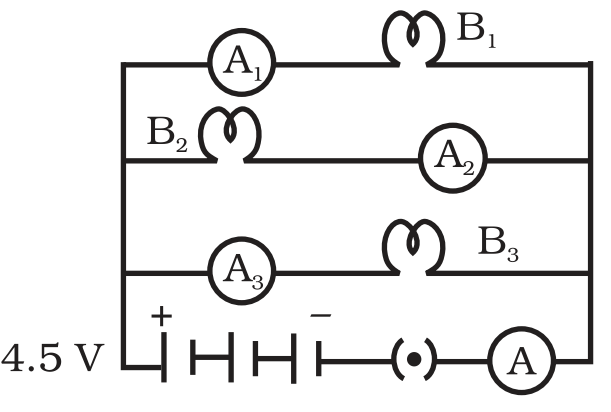
$B _1, B_2$ and $B _3$ are three identical bulbs connected as shown in Figure. When all the three bulbs glow, a current of 3 A is recorded by the ammeter A .
  1. What happens to the glow of the other two bulbs when the bulb gets fused?
  2. What happens to the reading of $A_1, A_2, A_3$ and $A$ when the bulb $B_2$ gets fused?
  3. How much power is dissipated in the circuit when all the three bulbs glow together?
Describe how washing soda is produced starting from sodium chloride (common salt). Write equations of all the reactions involved.