MCQ
Oxygen and hydrogen gases are at the same temperature $T.$ The kinetic energy of an oxygen molecule will be equal to:
  • A
    $16$ times the kinetic energy of a hydrogen molecule.
  • B
    $5$ times the kinetic energy of a hydrogen molecule.
  • The kinetic energy of a hydrogen molecule.
  • D
    One$-$fourth the kinetic energy of a hydrogen molecule.

Answer

Correct option: C.
The kinetic energy of a hydrogen molecule.

Need a full question paper?

Generate a complete, print-ready paper with questions like this in minutes — across 16+ boards, with answer keys.

Start Generating Free

Similar questions

A particle moves in a plane along an elliptic path given by $\frac{x^2}{a^2}+\frac{y^2}{b^2}=1$. At point $(0, b)$, the $x$-component of velocity is $u$. The $y$-component of acceleration at this point is
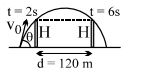
A projectile crosses two walls of equal height $H$ symmetrically as shown The angle of projection of the projectile is
A man sitting in a moving train hears the whistle of the engine. The frequency of the whistle is $600 Hz$
A moves with $65 \,km/h $ while $B$ is moving in same direction of $A$ with $80\, km/h$. The relative velocity of $B$ with respect to $A$ is......... $km/h$
Two lithium nuclei in a lithium vapour at room temperature do not combine to form a carbon nucleus because:
A glass tube $1.5 m$ long and open at both ends, is immersed vertically in a water tank completely. A tuning fork of $660 Hz$ is vibrated and kept at the upper end of the tube and the tube is gradually raised out of water. The total number of resonances heard before the tube comes out of water, taking velocity of sound air $330 m/sec$ is
What is the moment of inertia of a square sheet of side $l$ and mass per unit area $\mu $ about an axis passing through the centre and perpendicular to its plane
A man is running at a speed of $5\, m/s$, the rain drops appear to be falling at an angle of $45^o$ from the vertical. If the rain drops are actually falling vertically downwards, then velocity of rain drops (in $m/s$) is
Which of the four arrangements in the figure correctly shows the vector addition of two forces $\overrightarrow {{F_1}} $ and $\overrightarrow {{F_2}} $ to yield the third force $\overrightarrow {{F_3}} $
A uniform metal wire of density $\rho $, cross-sectional area $A$ and length $L$ is stretched with a tension $T$. The speed of transverse wave in the wire is given by