MCQ
Oxygen molecule exhibits
- ✓Paramagnetism
- BDiamagnetism
- CFerromagnetism
- DFerrimagnetism
Generate a complete, print-ready paper with questions like this in minutes — across 16+ boards, with answer keys.
Statement $I$ : Bromination of phenol in solvent with low polarity such as $\mathrm{CHCl}_3$ or $\mathrm{CS}_2$ requires Lewis acid catalyst.
Statement $II$ : The lewis acid catalyst polarises the bromine to generate $\mathrm{Br}^{+}$.
In the light of the above statements, choose the correct answer from the options given below :
What is structure of $(A)$ ?
The original compound showed these properties also :
$\mathop {{C_9}{H_{12}}{O_2}}\limits_{(A)} \,\xrightarrow{{Na}}\,{H_2}$ liberated
$\mathop {{C_9}{H_{12}}{O_2}}\limits_{(A)} \,\xrightarrow{{Br}}$ no rapid reaction
$\mathop {{C_9}{H_{12}}{O_2}}\limits_{(A)} \,\xrightarrow[{cool}]{{Cr{O_3}\,/\,{H^ + }}}{C_9}{H_8}{O_3}$
$A$ $+$ $\begin{array}{*{20}{c}}
{C{H_3} - C - C{H_3}} \\
{||\,} \\
{O\,\,\,}
\end{array}$ $→$ $B$ $'B'$ is
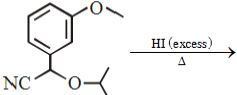
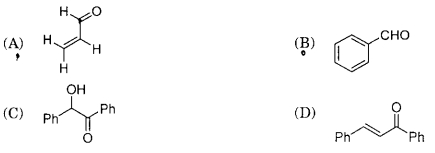
$Cr\, | \,Cr^{3+}_{(0.1\,M)}\,||\, Fe^{2+}_{(0.01\, M)}\,|\, Fe$ is ......... $V$
$(a)$ $K_2PtCl_6$ $(b)$ $PtCl_4 . 2NH_3$
$(c)$ $PtCl_4 . 3NH_3$ $(d)$ $PtCl_4 . 5NH_3$
Their electrical conductances in aqueous solutions are