MCQ
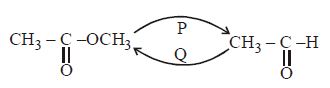
$P$ & $Q$ respectively is -
  • A
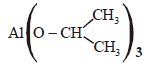
    $DI-BALH$ followed by $H_2O$ and $Al(OCH_2CH_3)_3$
  • B
    $LiAlH_4$ followed by $H_2O$ and  
  • $DI-BALH$ followed by $H_2O$ and $m-CPBA$ followed by $C{H_3}OH/{H^ + }$
  • D
    None of these

Answer

Correct option: C.
$DI-BALH$ followed by $H_2O$ and $m-CPBA$ followed by $C{H_3}OH/{H^ + }$
c

Need a full question paper?

Generate a complete, print-ready paper with questions like this in minutes — across 16+ boards, with answer keys.

Start Generating Free

Similar questions

Which of the following statement is not true about Mohr's salt
The compound formed by the reaction of ethanal with semicarbazide contains.....................number of nitrogen atoms.
Which can show metamerism
Compound $A$ (molecular formula $C_3 H_8O$) is treated with acidified  potassium dichromate to form a product $B$ (molecular formula $C_3H_6O$). $B$ forms a shining silver mirror on warming with ammonical silver nitrate, $B$ when treated with an aqueous solution of $NH_2NHCONH_2$ and sodium  acetate gives a product $C$. Identify the structure of $C$.
In a particular isomer of $[Co(NH_3)4Cl_2]^0,$ the $Cl - Co - Cl$ angle is $90^o ,$ the isomer is known as
Barium ions$, \mathrm{CN}^{-}$ and $\mathrm{Co}^{2+}$ form an ionic complex. If that complex is supposed to be $75 \%$ ionised in water with vant Hoff factor $' i\ '$ equal to four, then the coordination number of $\mathrm{Co}^{2+}$ in the complex can be.
$50\, ml$ of $0.2\, M$ solution of a compound with empirical formula $CoCl_3.4\,NH_3$ on treatment with excess of $AgNO_3(aq)$ yields $1.435\, g$ of $AgCl.$ Ammonia is not removed by treatment with concentrated $H_2SO_4.$ The formula of the compound is :
A $250.0\,mL$ sample of a $0.20\,M\,Cr^{3+}$ is electrolyzed with a current of $96.5\,A$ . If the remaining $[Cr^{3+}]$ is $0.1\,M$ the duration of process is .............. $\mathrm{s}$ (Atomic weight of $Cr = 52$ )
Which of the following is not a heterogeneous adsorption