In p-block, when we move from left to right in a period, the acidic character of the oxides increases due to increase in electronegativity. For example,
In 2nd period B2O3 < CO2 < N2O3 (acidic nature increases).
In 3rd period A12O3 < SiO2 < P4O10 < SO3 < C12O7 (acidic character increases).
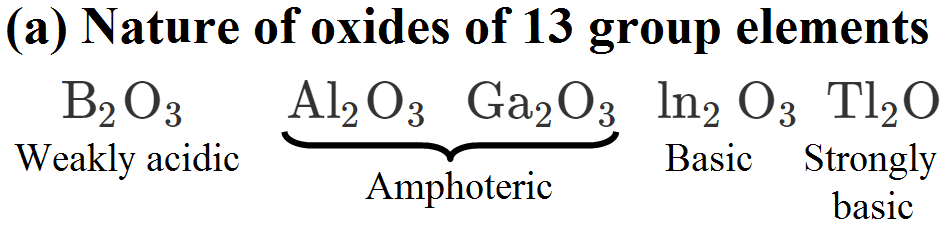
On moving down the group, acidic character decreases and basic character increases, e.g.,
- Nature of oxides of 15 group elements.
$\text{N}_2\text{O}_5\ \ \ \ \ \ \ \ \ \ \ \ \ \ \ \ \ \ \ \ \ \ \text{P}_4\text{O}_{10}\ \ \ \ \ \ \ \ \ \ \ \ \ \ \ \ \ \ \ \text{As}_4\text{O}_{10}\ \ \ \ \ \ \ \ \ \ \text{Sb}_4\text{O}_{10}\ \ \ \ \ \ \ \ \ \ \text{Bl}_2\text{O}_3\\ ^\text{Strongly acidic}\ \ \ \ \ \ \ \ \ ^\text{Moderately acidic}\ \ \ \ \ \ \ \ \ \ \ ^\text{Amphoteric}\ \ \ \ \ \ \ \ ^\text{Amphoteric}\ \ \ \ \ \ \ \ \ \ ^\text{Basic}$
Among the oxides of same element, higher the oxidation state of the element, stronger is the acid. For example, SO3 is a stronger acid than SO2.
B2O3 is weakly acidic and on dissolution in water, it forms orthoboric acid. Orthoboric acid does not act as a protonic acid (it does not ionise) but acts as a weak Lewis acid.
$\text{B}_2\text{O}_3\ \ \ \ \ \ \ \ \ \ +\ \ \ \ \ \ \ 3\text{H}_2\text{O}\ \ \ \rightleftharpoons\ \ \ \ 2\text{H}_3\text{BO}_3\\^\text{Boron trioxide}\ \ \ \ \ \ \ \ \ \ \ \ \ \ \ \ \ \ \ \ \ \ \ \ \ \ \ \ \ \ \ \ \ \ \ \ ^\text{Orthoboric acid}$
$\text{B(OH)}_3\ +\ \text{H}-\text{OH}\xrightarrow{\ \ \ \ \ \ \ \ \ \ \ \ }\big[\text{B}(\text{OH})_4\big]^{-}+\text{H}^+$
Al2O3 is amphoteric in nature. It is insoluble in water but dissolves in alkalies and reacts with acids.
$\text{Al}_2\text{O}_3\ \ +\ \ 2\text{NaOH}\ \xrightarrow{\ \ \ \ \ \ \ {\Delta} \ \ \ \ \ \ \ \ }\ 2\text{NaAlO}_2\ \ +\ \ \text{H}_2\text{O}\\ ^\text{Aluminium}\ \ \ \ \ \ \ \ \ \ \ \ \ \ \ \ \ \ \ \ \ \ \ \ \ \ \ \ \ \ \ \ \ \ \ \ \ \ ^\text{Sodium meta}\\ \ \ ^\text{trioxide}\ \ \ \ \ \ \ \ \ \ \ \ \ \ \ \ \ \ \ \ \ \ \ \ \ \ \ \ \ \ \ \ \ \ \ \ \ \ \ \ \ \ \ ^\text{chloride}$
$\text{Al}_2\text{O}_3\ \ +\ \ 6\text{HCl}\ \xrightarrow{\ \ \ \ \ \ \ {\Delta} \ \ \ \ \ \ \ \ }\ 2\text{AlCl}_3\ \ +\ \ 3\text{H}_2\text{O}\\ \ \ \ \ \ \ \ \ \ \ \ \ \ \ \ \ \ \ \ \ \ \ \ \ \ \ \ \ \ \ \ \ \ \ \ \ \ \ \ \ \ \ \ \ \ \ \ \ ^\text{Aluminium}\\ \ \ \ \ \ \ \ \ \ \ \ \ \ \ \ \ \ \ \ \ \ \ \ \ \ \ \ \ \ \ \ \ \ \ \ \ \ \ \ \ \ \ \ \ \ \ \ \ \ \ ^\text{chloride}$
Tl2O is as basic as NaOH due to its lower oxidation state (+1).
$\text{Tl}_2\text{O}\ +\ 2\text{HCl}\ \xrightarrow{\ \ \ \ \ \ \ \ \ \ \ \ }2\text{TlCl}\ +\ \text{H}_2\text{O}$