MCQ
$p-n$ junction diode acts as:
  • A
    ohmic resistance
  • non$-$ohmic resistance
  • C
    both $A$ and $B$
  • D
    amplifier

Answer

Correct option: B.
non$-$ohmic resistance
We know that in the case of metallic conductors, the potential difference varies in direct proportion to the current flowing. The $I−V$ graph of a ohmic conductor is a straight line. But, a $p-n$ junction diode is not in according with Ohm's law. The current voltage characteristic curve of a $p-n$ junction diode shows both forward bias as well as reverse bias characteristics as shown as in the graph.

Need a full question paper?

Generate a complete, print-ready paper with questions like this in minutes — across 16+ boards, with answer keys.
Start Generating Free

Similar questions

$A$ planoconvex lens, when silvered at its plane surface is equivalent to a concave mirror of focal length $28cm$. When its curved surface is silvered and the plane surface not silvered, it is equivalent to a concave mirror of focal length $10cm$, then the refractive index of the material of the lens is :
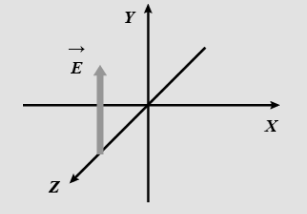
The figure here gives the electric field of an $EM$ wave at a certain poiunt and a certain instrant. the wave is transporting energy in the negative $z$ direction. what is tha direction of the magnetic field of the wave at that point and instant.
The force between point charges kept in vacuum is 18 Newton. If a glass plate of dielectric constant 6 is placed between these charges, then the value of force will be:
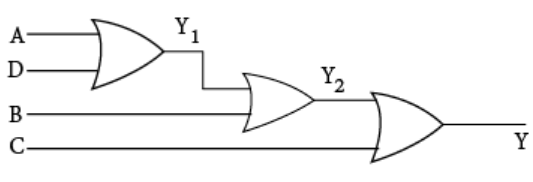
The expression of $Y$ in the above circuit is:
Convex lens is not used in:
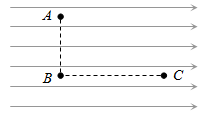
Figure shows three points A, B and C in a region of uniform electric field $\vec E$. The line AB is perpendicular and BC is parallel to the field lines. Then which of the following holds good. Where $V_A,V_B$ and $V_C$ represent the electric potential at points A, B and C respectively
Rutherford’s $\alpha$-particle experiment showed that the atoms have
An electric dipole is placed along the $x - $ axis at the origin $O$. A point $P$ is at a distance of $20\,cm$ from this origin such that $OP$ makes an angle $\frac{\pi }{3}$ with the $x-$axis. If the electric field at $P$ makes an angle $\theta $ with the $x$-axis, the value of $\theta $ would be
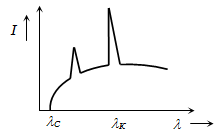
The intensity of X-rays from a Coolidge tube is plotted against wavelength as shown in the figure. The minimum wavelength found is $\lambda_c$ and the wavelength of the $K_\alpha$ line is $\lambda_k$. As the accelerating voltage is increased
Pick out the material that cannot be used to make permanent magnets.