MCQ
Penetrating power of $X$-rays increases with increase in
- ✓Accelerating potential
- BWavelength
- CMass number of the target material
- DFilament current
Penetrating power depends on energy of the $x$-wave which depends on the accelerating potential of the $X$-ray tube.
Generate a complete, print-ready paper with questions like this in minutes — across 16+ boards, with answer keys.
( $\delta$ ) produced by the combination is $\left(\frac{1}{x}\right)^{\circ}$. The value of $x$ is.......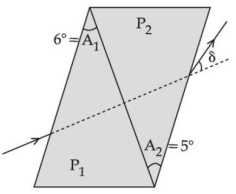
| Column $I$ | Column $II$ |
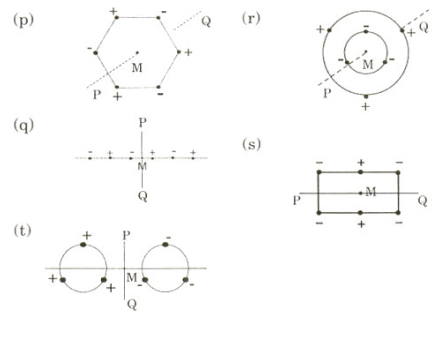
| $(A)$ $E=0$ | $Image$ Charges are at the corners of a regular hexagon. $\mathrm{M}$ is at the centre of the hexagon. $\mathrm{PQ}$ is perpendicular to the plane of the hexagon. |
| $(B)$ $V \neq 0$ | $Image$ Charges are on a line perpendicular to $\mathrm{PQ}$ at equal intervals. $\mathrm{M}$ is the mid-point between the two innermost charges. |
| $(C)$ $B=0$ | $Image$ Charges are placed on two coplanar insulating rings at equal intervals. $\mathrm{M}$ is the common centre of the rings. $\mathrm{PQ}$ is perpendicular to the plane of the rings. |
| $(D)$ $\mu \neq 0$ | $Image$ Charges are placed at the corners of a rectangle of sides $a$ and $2 a$ and at the mid points of the longer sides. $\mathrm{M}$ is at the centre of the rectangle. $\mathrm{PQ}$ is parallel to the longer sides. |
| $Image$ Charges are placed on two coplanar, identical insulating rings at equal intervals. $\mathrm{M}$ is the mid-point between the centres of the rings. $\mathrm{PQ}$ is perpendicular to the line joining the centres and coplanar to the rings. |