MCQ
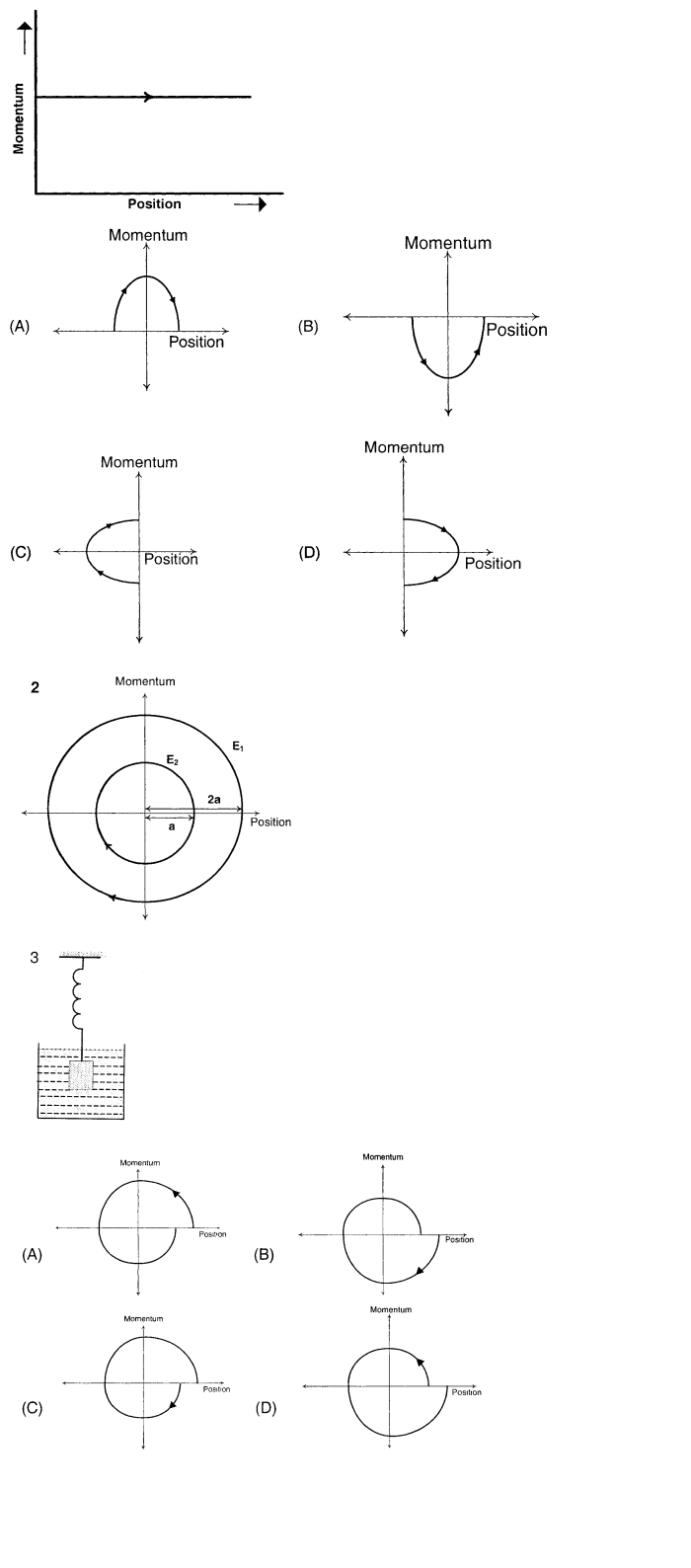
Phase space diagrams are useful tools in analyzing all kinds of dynamical problems. They are especially useful in studying the changes in motion as initial position and momentum are changed. Here we consider some simple dynamical systems in one-dimension. For such systems, phase space is a plane in which position is plotted along horizontal axis and momentum is plotted along vertical axis. The phase space diagram is $x(t)$ vs. $p(t)$ curve in this plane. The arrow on the curve indicates the time flow. For example, the phase space diagram for a particle moving with constant velocity is a straight line as shown in the figure. We use the sign convention in which position or momentum upwards (or to right) is positive and downwards (or to left) is negative. $Image$

$1.$ The phase space diagram for a ball thrown vertically up from ground is

mcq $Image$

$2.$ The phase space diagram for simple harmonic motion is a circle centered at the origin. In the figure, the two circles represent the same oscillator but for different initial conditions, and $E_1$ and $E_2$ are the total mechanical energies respectively. Then $Image$

$(A)$ $ E_1=\sqrt{2} E_2$ $(B)$ $ E_1=2 E_2$

$(C)$ $ E_1=4 E_2$ $(D)$ $ E_1=16 E_2$

$3.$ Consider the spring-mass system, with the mass submerged in water, as shown in the figure. The phase space diagram for one cycle of this system is $Image$

mcq $Image$

Give the answer question $1,2$ and $3.$
  • $(D,C,B)$
  • B
    $(A,B,C)$
  • C
    $(B,B,D)$
  • D
    $(D,A,D)$

Answer

Correct option: A.
$(D,C,B)$
a
$2.$ From diagram, Amplitude of oscillator $1=2 \times$ (Amplitude of oscillator $2$ )

$\Rightarrow E _1=4 E _2$

Need a full question paper?

Generate a complete, print-ready paper with questions like this in minutes — across 16+ boards, with answer keys.

Start Generating Free

Similar questions

A bomb is released from a horizontal flying aeroplane. The trajectory of bomb as observed from ground is:
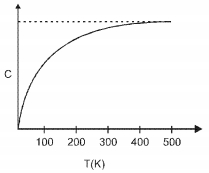
The figure below shows the variation of specific heat capacity $(C)$ of a solid as a function of temperature $(T)$. The temperature is increased continuously from $0$ to $500 \ K$ at a constant rate. Ignoring any volume change, the following statement$(s)$ is (are) correct to a reasonable approximation.$Image$

$(A)$ the rate at which heat is absorbed in the range $0-100 \ K$ varies linearly with temperature $T$.

$(B)$ heat absorbed in increasing the temperature from $0-100 \ K$ is less than the heat required for increasing the temperature from $400-500 \ K$.

$(C)$ there is no change in the rate of heat absorbtion in the range $400-500 \ K$.

$(D)$ the rate of heat absorption increases in the range $200-300 \ K$.

Two forces of $10 \,N$ and $6 \,N$ act upon a body. The direction of the forces are unknown. The resultant force on the body may be .........$N$
A certain string will resonant to several frequencies, the lowest of which is $200 \,cps$. What are the next three higher frequencies to which it resonants?
$Assertion :$ A bubble comes from the bottom of a lake to the top.
$Reason :$ Its radius increases.
The rate of loss of heat from a body cooling under conditions of forced convection is proportional to its $(A)$ heat capacity $(B)$ surface area $(C)$ absolute temperature $(D)$ excess of temperature over that of surrounding : state if
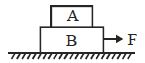
In figure, the coefficient of friction between the floor and the block $B$ is $0.1$. The coefficient of friction between the blocks $B$ and $A$ is $0.2$. The mass of $A$ is $\frac{m}{2}$  and of $B$ is $m$. ........ $mg$  is the maximum horizontal force $F$ can be applied to the block $B$ so that two blocks move together ?
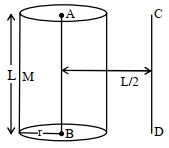
The solid cylinder of length $80\, {cm}$ and mass ${M}$ has a radius of $20\, {cm}$. Calculate the density of the material used if the moment of inertia of the cylinder about an axis $CD$ parallel to ${AB}$ as shown in figure is $2.7\, {kg} {m}^{2}$
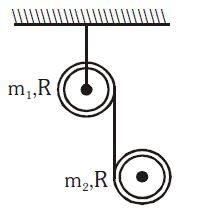
In the given figure linear acceleration of solid cylinder of mass $m_2$ is $a_2$. Then angular acceleration $\alpha_2$ is (given that there is no slipping).
A standing wave pattern is formed on a string. One of the waves is given by equation ${y_1} = a\,\cos \,\left( {\omega t - kx + \pi /3} \right)$ then the equation of the other wave such that at $x = 0$ a node is formed