MCQ
Photo-electric effect can be explained by
  • A
    Corpusular theory of light
  • B
    Wave nature of light
  • C
    Bohr’s theory
  • Quantum theory of light

Answer

Correct option: D.
Quantum theory of light
d
(d) Quantum theory of light can explain the photoelectric effect that if a quanta of photon is incidented on the metal surface, the energy of photon breaks the electronnucleus interaction and thus an electron is emitted from the metal surface. Since some energy is required to break that interaction to emit the electron, so the photoelectric effect takes place from the metal surface only if the energy of photon is greater than the work function of that metal.

Need a full question paper?

Generate a complete, print-ready paper with questions like this in minutes — across 16+ boards, with answer keys.
Start Generating Free

Similar questions

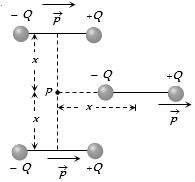
Three identical dipoles are arranged as shown below. What will be the net electric field at $P$ $\left( {k = \frac{1}{{4\pi {\varepsilon _0}}}} \right)$
A small object is placed at a distance of $4 \,m$ from the objective of a telescope of focal length $2 \,m$. The focal length of the eyepiece is $0.2 m$. The final image of the object
An ideal battery of $4\, V$ and resistance $R$ are connected in series in the primary circuit of a potentiometer of length $1\, m$ and resistance $5\,\Omega $ . The value of $R$, to give a difference of $5\, mV$ across $10\, cm$ of potentiometer wire, is: ................ $\Omega$
An earthquake generates both transverse $(S)$ and longitudinal $(P)$ sound waves in the earth. The speed of $S$ waves is about $4.5 \,km/s$ and that of $P$ waves is about $8.0 \,km/s.$ A seismograph records $P$ and $S$ waves from an earthquake. The first $P$ wave arrives $4.0\, min$ before the first $S$ wave. The epicenter of the earthquake is located at a distance about .... $km$
A particle is projected horizontally from a tower with velocity $10\,m / s$. Taking $g=10\,m / s ^2$. Match the following two columns at time $t=1\,s$.
Column $I$ Column $II$
$(A)$ Horizontal component of velocity $(p)$ $5$ SI unit
$(B)$ Vertical component of velocity $(q)$ $10$ SI unit
$(C)$ Horizontal displacement $(r)$ $15$ SI unit
$(D)$ Vertical displacement $(s)$ $20$ SI unit
A proton and a deutron ( $\mathrm{q}=+\mathrm{e}, m=2.0 \mathrm{u})$ having same kinetic energies enter a region of uniform magnetic field $\vec{B}$, moving perpendicular to $\vec{B}$. The ratio of the radius $r_d$ of deutron path to the radius $r_p$ of the proton path is:
Which level of the single ionized carbon has the same energy as the ground state energy of hydrogen atom ?
Two vessels of different materials are similar in size in every respect. The same quantity of ice filled in them gets melted in $20$ minutes and $30$ minutes. The ratio of their thermal conductivities will be
For the production of $X-$ rays, the target should be made of
A capacitor is connected to a cell of $emf$ $E$ having some internal resistance $r$. The potential difference across the