a
Given $\phi_p=2.0 \ eV , \phi_{ q }=2.5 \ eV$ and $\phi_{ r }=3.0 \ eV$
From the above we can find the cutoff wavelength for each plate $\lambda_p=621 \ nm$, $\lambda_q=496 \ nm$ and $\lambda_r=414 \ nm$
It's mentioned that each plate is illuminated by a light that consists of $3$ different wavelengths i.e. $550 \ nm , 450 \ nm , 350 \ nm$ of equal intensities.
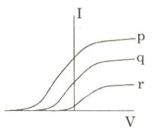
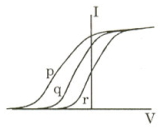
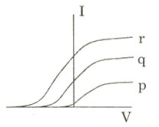
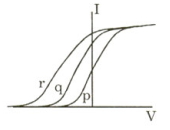
Now since the cut off wavelength of plate $p$ is higher than all $3$ incident wavelengths so all $3$ types of photons will contribute to photoelectrons. Whereas in the case of plate q incident photons of wavelength $450 \ nm$ won't be able to contribute in photocurrent as it is higher than it's cut off wavelength of $496 \ nm$. So naturally its photo current will be lesser than the plate $p$ since its being excited by only $2$ wavelegths. In case of plate $r, 2$ incident wavelengths i.e. $550 \ nm$ and $450 \ nm$ won't be able to excite the photo electrons. Hnece its photocurrent will be only due to photon of wavelength $350 \ nm$ and hence will be least.
$I_p