Question
Photoelectric effect was successfully explained first by
|
(a) Planck |
(b) Hallwash |
(c) Hertz |
(d) Einstein |
Photoelectric effect was successfully explained first by
|
(a) Planck |
(b) Hallwash |
(c) Hertz |
(d) Einstein |
(d) Einstein
Generate a complete, print-ready paper with questions like this in minutes — across 16+ boards, with answer keys.
A proton is about 1840 times heavier than an electron. When it is accelerated by a potential difference of 1 kV, its kinetic energy will be
|
(a) 1840 keV |
(b) 1/1840 keV |
(c) 1 keV |
(d) 920 keV |
The points resembling equal potentials are
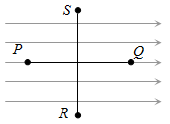
|
(a) P and Q |
(b) S and Q |
(c) S and R |
(d) P and R |
Assertion : For cooking in a microwave oven, food is always kept in metal containers.
Reason : The energy of microwave is easily transferred to the food in metal container.
|
(a) If both assertion and reason are true and the reason is the correct explanation of the assertion. |
|
(b) If both assertion and reason are true but reason is not the correct explanation of the assertion. |
|
(c) If assertion is true but reason is false. |
|
(d) If the assertion and reason both are false. |
Given below are symbols for some logic gates

The XOR gate and NOR gate respectively are
|
(a) 1 and 2 |
(b) 2 and 3 |
(c) 3 and 4 |
(d) 1 and 4 |
Two infinite plane parallel sheets separated by a distance d have equal and opposite uniform charge densities σ. Electric field at a point between the sheets is
|
(a) Zero |
(b) |
|
(c) |
(d) Depends upon the location of the point |
A silicon speciman is made into a P-type semi-conductor by dopping, on an average, one Indium atom per 5  silicon atoms. If the number density of atoms in the silicon specimen is 5
  then the number of acceptor atoms in silicon per cubic centimetre will be
|
(a) 2.5 |
(b) 1.0 |
|
(c) 1.0 |
(d) 2.5 |





