Question

Photon and electron are given same energy (. Wavelength associated with photon and electron are   and   then correct statement will be

(a) 

(b)  

(c)  

(d)  

Answer

(a) 

Need a full question paper?

Generate a complete, print-ready paper with questions like this in minutes — across 16+ boards, with answer keys.

Start Generating Free

Similar questions

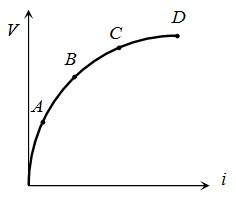
Variation of current passing through a conductor as the voltage applied across its ends as varied is shown in the adjoining diagram. If the resistance (R) is determined at the points A, B, C and D, we will find that

(a) RC = RD

(b) RB > RA

(c) RC > RB

(d) None of these

Two charges +3.2   and -3.2  kept 2.4 Å apart forms a dipole. If it is kept in uniform electric field of intensity  4   then what will be its electrical energy in equilibrium

(a) + 3

(b) -3  

(c) -6  

(d) -2  

In a coaxial, straight cable, the central conductor and the outer conductor carry equal currents in opposite directions. The magnetic field is zero:
  1. Outside the cable.
  2. Inside the inner conductor.
  3. Inside the outer conductor.
  4. In between the tow conductors.
Magnetic field at a point on axis is equal to magnetic field at point on equator of bar magnet ratio of these distance will be __________ .
The capacitive reactance in an AC circuit is.
Which of the following graph represents magnetic field (B) versus distance $r$ from the centre of a long straight conducting wire of uniform cross sectional area carrying steady current I and radius $a$ ?

To form a composite 16Μf, 1000 V  capacitor from a supply of identical capacitors marked 8 μF, 250 V we require a minimum number of capacitors

(a) 40

(b) 32

(c) 8  

(d) 2

The forces in which sum of kinetic energy and potential energy is conserved are called as:

A source of e.m.f. E = 15 V and having negligible internal resistance is connected to a variable resistance so that the current in the circuit increases with time as i = 1.2 t + 3. Then, the total charge that will flow in first five second will be

(a) 10 C

(b) 20 C

(c) 30 C

(d) 40 C

A radioactive nucleus undergoes a-emission to form a stable element. What will be the recoil velocity of the daughter nucleus if V is the velocity of a-emission and A is the atomic mass of radioactive nucleus

(a)     

(b)  

(c)   

(d)