MCQ
Pick out the statement which is not true
  • A
    IR radiations are used for long distance photography
  • IR radiations arise due to inner electron transitions in atoms
  • C
    IR radiations are detected by using a bolometer
  • D
    Sun is the natural source of IR radiation
Answer

Correct option: B.
IR radiations arise due to inner electron transitions in atoms
b
The primary source of infrared radiation is heat or thermal radiation. This is the radiation produced by the motion of atoms and molecules in an object. When an object is not quite hot enough to radiate visible light, it will emit most of its energy in the infrared.

Need a full question paper?

Generate a complete, print-ready paper with questions like this in minutes — across 16+ boards, with answer keys.

Start Generating Free

Similar questions

A car of mass $1000\,kg$ is moving at a speed of $30\,m/s.$ Brakes are applied to bring the car to rest. If the net retarding force is $5000\,N,$ the car comes to stop after travelling $d\,m$ in $t\,s.$ Then
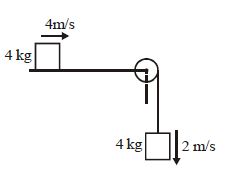
Two blocks of same mass $(4\ kg)$ are placed according to diagram. Initial velocities of bodies are $4\ m/s$ and $2\ m/s$ and the string is taut. Find the impulse on $4\ kg$ when the string again becomes taut  .......... $N-s$
One mole of a monoatomic gas is mixed with three moles of a diatomic gas. The molecular specific heat of mixture at constant volume is $\frac{\alpha^{2}}{4} R J / mol\,K$; then the value of $\alpha$ will be $.......$ (Assume that the given diatomic gas has no vibrational mode.)
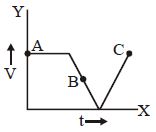
The velocity time graph of a body is shown in Figure. It implies that at point $B$ :-
A uniform cylindrical rod of length $L$ and radius $r$, is made from a material whose Young's modulus of Elasticity equals $Y$. When this rod is heated by temperature $T$ and simultaneously subjected to a net longitudinal compressional force $F$, its length remains unchanged. The coefficient of volume expansion, of the material of the rod, is (nearly) equals to
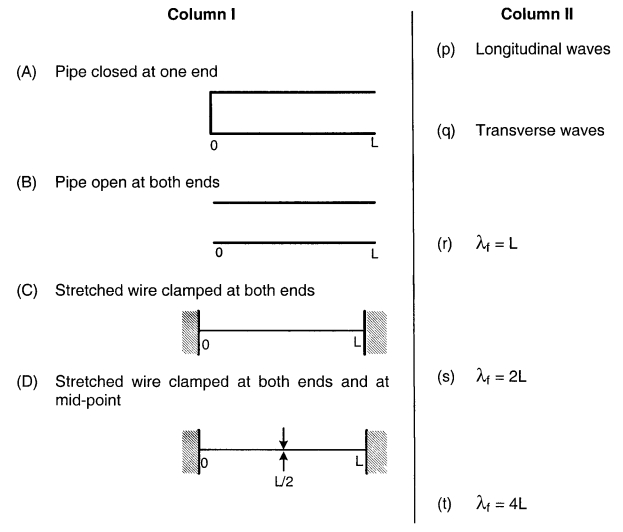
Column $I$ shows four systems, each of the same length $L$, for producing standing waves. The lowest possible natural frequency of a system is called its fundamental frequency, whose wavelength is denoted as $\lambda_{ f }$. Match each system with statements given in Column $II$ describing the nature and wavelength of the standing waves.
One end of a light spring of spring constant k is fixed to a wall and the other end is tied to a block placed on a smooth horizontal surface. In a displacement, the work done by the spring is $\frac{1}{2}\text{kx}^2.$ The possible cases are:
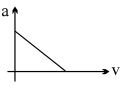
Acceleration versus velocity graph of a particle moving in a straight line starting from rest is as shown in figure. The corresponding velocity-time graph would be
The dimensions of power are
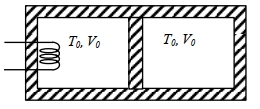
A thermally insulating cylinder has a thermally insulating and frictionless movable partition in the middle, as shown in the figure below. On each side of the partition, there is one mole of an ideal gas, with specific heat at constant volume, $C_v=2 R$. Here, $R$ is the gas constant. Initially, each side has a volume $V_0$ and temperature $T_0$. The left side has an electric heater, which is turned on at very low power to transfer heat $Q$ to the gas on the left side. As a result the partition moves slowly towards the right reducing the right side volume to $V_0 / 2$. Consequently, the gas temperatures on the left and the right sides become $T_L$ and $T_R$, respectively. Ignore the changes in the temperatures of the cylinder, heater and the partition.

($1$) The value of $\frac{T_R}{T_0}$ is

$(A)$ $\sqrt{2}$ $(B)$ $\sqrt{3}$ $(C)$ $2$ $(D)$ $3$

($2$) The value of $\frac{Q}{R T_0}$ is

$(A)$ $4(2 \sqrt{2}+1)$ $(B)$ $4(2 \sqrt{2}-1)$ $(C)$ $(5 \sqrt{2}+1)$ $(D)$ $(5 \sqrt{2}-1)$

Give the answer or qution ($1$) and ($2$)