Pick out the wrong statement
Easy
Download our app for free and get started
(b) As temperature increases resistance of filament also increases.

Download our appand get started for free
Experience the future of education. Simply download our apps or reach out to us for more information. Let's shape the future of learning together!No signup needed.*
Similar Questions
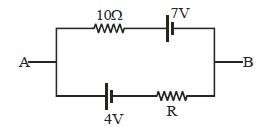
- 1In the following circuit if $V_A -V_B = 6\,V$ then the value of resistance $R$ (in $ohm$) is ............... $\Omega$View Solution
- 2A $2\, W$ carbon resistor is color coded with green, black, red and brown respectively. The maximum current which can be passed through this resistor is .............. $mA$View Solution
- 3The current flowing through a conductor connected across a source is $2\,A$ and $1.2\,A$ at $0^{\circ}\,C$ and $100^{\circ}\,C$ respectively. The current flowing through the conductor at $50^{\circ}\,C$ will be $......\times 10^2\,mA$.View Solution
- 4$A$ brass disc and a carbon disc of same radius are assembled alternatively to make a cylindrical conductor. The resistance of the cylinder is independent of the temperature. The ratio of thickness of the brass disc to that of the carbon disc is [$\alpha$ is temperature coefficient of resistance and Neglect linear expansion ]View Solution
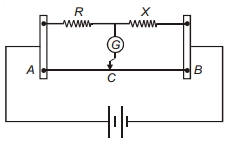
- 5In the meter bridge shown, the resistance $X$ has a negative temperature coefficient of resistance. Neglecting the variation in other resistors, when current is passed for some time, in the cirucit, balance point should shift towards.View Solution
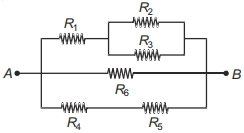
- 6View SolutionConsider the combination of resistors as shown in figure and pick out the correct statement
- 7A copper wire of length $10\,m$ and radius $\left(10^{-2} / \sqrt{\pi}\right) m$ has electrical resistance of $10 \,\Omega$. The current density in the wire for an electric field strength of $10( V / m )$ is :View Solution
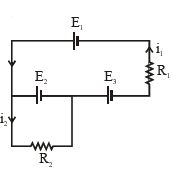
- 8The current $i_1$ and $i_2$ through the resistors $R_1(=10\,\Omega )$ and ${R_2}\left( { = 30\,\Omega } \right)$ in the circuit diagram with $E_1 = 3\,V$, $E_2 = 3\,V$ and $E_3 = 2\,V$ are respectivelyView Solution
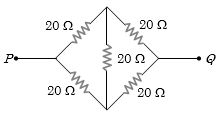
- 9The equivalent resistance between $P$ and $Q$ in the given figure, is ............... $\Omega$View Solution
- 10View SolutionConductivity increases in the order of