The equivalent resistance between $P$ and $Q$ in the given figure, is ............... $\Omega$
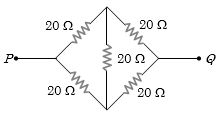
Easy


Download our appand get started for free
Experience the future of education. Simply download our apps or reach out to us for more information. Let's shape the future of learning together!No signup needed.*
Similar Questions
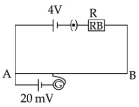
- 1As shown in the figure, a potentiometer wire of resistance $20\,\Omega$ and length $300\,cm$ is connected with resistance box (R.B.) and a standard cell of emf $4\,V$. For a resistance ' $R$ ' of resistance box introduced into the circuit, the null point for a cell of $20\,mV$ is found to be $60\,cm$. The value of ' $R$ ' is $.....\Omega$View Solution
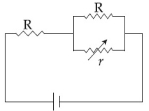
- 2In the circuit shown, the resistance $r$ is a variable resistance. If for $r = fR,$ the heat generation in $r$ is maximum then the value of $f$ isView Solution
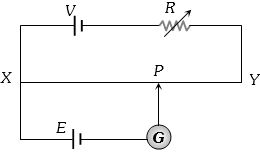
- 3A potentiometer circuit shown in the figure is set up to measure $e.m.f.$ of a cell $E$. As the point $P$ moves from $X$ to $Y$ the galvanometer $G$ shows deflection always in one direction, but the deflection decreases continuously until $Y$ is reached. In order to obtain balance point between $X$ and $Y$ it is necessary toView Solution
- 4View SolutionConsider four circuits shown in the figure below. In which circuit power dissipated is greatest (Neglect the internal resistance of the power supply)
- 5The $e.m.f.$ of a standard cell balances across $150\, cm$ length of a wire of potentiometer. When a resistance of $2\,\Omega $ is connected as a shunt with the cell, the balance point is obtained at $100\,cm$. The internal resistance of the cell is .............. $\Omega $View Solution
- 6Which of the following graph represents the variation of resistivity ( $\rho$ ) with temperature $(T)$ for copper $?$View Solution
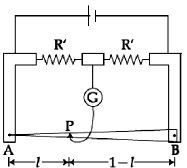
- 7In a meter bridge, the wire of length $1\, m$ has a nonuniform cross-section such that, the variation $\frac{{dR}}{{d\ell }}$ of its resistance $R$ with length $\ell $ is $\frac{{dR}}{{d\ell }} \propto \frac{1}{{\sqrt \ell }}$ Two equal resistances are connected as shown in the figure. The galvanometer has zero deflection when the jockey is at point $P$. What is the length $AP$ ? ................ $m$View Solution
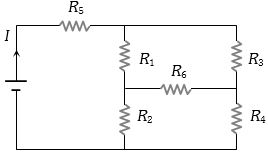
- 8In the given circuit, it is observed that the current $I$ is independent of the value of the resistance $R_6$. Then the resistance values must satisfyView Solution
- 9View SolutionEmf is most closely related to
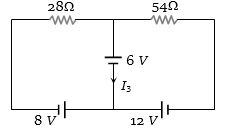
- 10Consider the circuit shown in the figure. The current ${I_3}$ is equal toView Solution