MCQ
Pick the correct statements:
  • A
    Average speed of a particle in a given time is never less than the magnitude of the average velocity.
  • B
    It is possible to have a situation in which $\Big|\frac{\text{d}\vec{\text{v}}}{\text{dt}}\Big|\neq0$ but $\frac{\text{d}}{\text{dt}}|\vec{\text{v}}|=0.$
  • C
    The average velocity of a particle is zero in a time interval. It is possible that the instantaneous velocity is never zero in the interval.
  • All of the above

Answer

Correct option: D.
All of the above
  1. Average speed of a particle in a given time is never less than the magnitude of the average velocity.
  2. It is possible to have a situation in which $\Big|\frac{\text{d}\vec{\text{v}}}{\text{dt}}\Big|\neq0$ but $\frac{\text{d}}{\text{dt}}|\vec{\text{v}}|=0.$
  3. The average velocity of a particle is zero in a time interval. It is possible that the instantaneous velocity is never zero in the interval.
Example, the motion of a particle on a circular track with a constant speed.
Average velocity $=\frac{\text{Displacement}}{\text{Total time}}$
$\text{Displacement}\leq\text{Distance}$
$\therefore\text{Average velocrty}\leq\text{Average speed}$
In uniform circular motion, speed is constant but velocity is not.
$\text{i.e.},\Big|\frac{\text{d}\vec{\text{v}}}{\text{dt}}\Big|\neq0$ but $\frac{\text{d}}{\text{dt}}=|\vec{\text{v}}|=0$ which proves case $(b)$
  1. In one complete circle of uniform motion, average velocity is zero. Instantaneous velocity is never zero in the interval.

Need a full question paper?

Generate a complete, print-ready paper with questions like this in minutes — across 16+ boards, with answer keys.

Start Generating Free

Similar questions

If the excess pressure inside a soap bubble is balanced by oil column of height $2\; mm$, then the surface tension of soap solution will be ($r = 1 \,cm$ and density $d = 0.8\, gm/cc$)
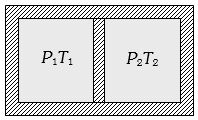
Following figure shows on adiabatic cylindrical container of volume ${V_0}$ divided by an adiabatic smooth piston (area of cross-section = $A$ ) in two equal parts. An ideal gas $({C_P}/{C_V} = \gamma )$ is at pressure $P_1$ and temperature $T_1$ in left part and gas at pressure $P_2$ and temperature $T_2$ in right part. The piston is slowly displaced and released at a position where it can stay in equilibrium. The final pressure of the two parts will be (Suppose $ x$ = displacement of the piston)
A person draws water from a $5\,m$ deep well in a bucket of mass $2\,kg$ of capacity $8\,litre$ by a rope of mass $1\,kg.$ What is the total work done by the person ? .............. $\mathrm{J}$ (Assume $g = 10\,m/sec^2$ )
A car is moving with a uniform speed on a level road. Inside the car there is a balloon filled with helium and attached to a piece of string tied to the floor. The string is observed to be vertical. The car now takes a left turn maintaining the speed on the level road. The balloon in the car will
The average translational energy and the $r.m.s.$ speed of molecules in a sample of oxygen gas at $300 K$ are $6.21 \times {10^{ - 21}}\,J$ and $484\, m/s$ respectively. The corresponding values at $600 K$ are nearly (assuming ideal gas behaviour)
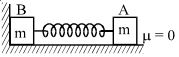
The block $A$ is pushed towards the wall by a distance and released. The normal reaction by vertical wall on the block $B$ $v/s$ compression in spring is given by :
Two Carnot engines $A$ and $B$ are operated in succession. The first one, $A$ receives heat from a source at ${T_1} = 800K$ and rejects to sink at ${T_2}K.$. The second engine $B$ receives heat rejected by the first engine and rejects to another sink at ${T_3} = 300K.$ If the work outputs of two engines are equal, then the value of ${T_2}$ is .... $K$
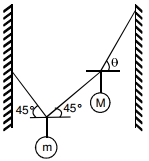
Two masses $m$ and $M$ are attached to the strings as shown in the figure. If the system is in equilibrium, then
A $150\, g$ tennis ball coming at a speed of $40\, m/s$ is hit straight back by a bat to a speed of $60\, m/s$. The magnitude of the average force $F$ on the ball, when it is in contact for $5\, ms$, is  ........... $N$
Consider a spacecraft in an elliptical orbit around the earth. At the low point, or perigee, of its orbit, it is $400 \ km$ above the earth's surface; at the high point, or apogee, it is $4000 \ km$ above the earth's surface. Using conservation of energy, find the speed at perigee and the speed at apogee. It is necessary to have the spacecraft escape from the earth completely.