MCQ
$pK_a$ of a weak acid $(HA)$ and $pK_b$ of a weak base $(BOH)$ are $3.2$ and $3.4,$ respectively. The $pH$ of their salt $(AB)$ solution is
  • A
    $7.2$
  • B
    $6.9$
  • $7.0$
  • D
    $1.0$

Answer

Correct option: C.
$7.0$
c
For the salt of weak acid and weak base, we have

$\mathrm{pH} =7+\frac{1}{2} \mathrm{p} K_{\mathrm{a}}-\frac{1}{2} \mathrm{p} K_{\mathrm{b}} $

$=7+\frac{1}{2}(3.2)-\frac{1}{2}(3.4) $

$=6.9$

Need a full question paper?

Generate a complete, print-ready paper with questions like this in minutes — across 16+ boards, with answer keys.

Start Generating Free

Similar questions

Four lowest energy levels of $H-$ atom are shown in the figure. The number of emission lines could be

$n = 4$______________
$n = 3$______________
$n = 2$ _____________
$n = 1$______________
Which of the following carbide gives alkane on hydrolysis :
The second ionisation enthalpy of the alkaline earth metals are smaller than that of corresponding group I metals. This is due to:
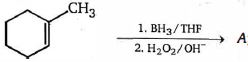
Product $A$ is
Born Haber cycle may be used to calculate
$I$. ${\Delta _{eg}}H$
$II.$ Mass number
$III.$ Electronegativity
$IV.$ Lattice energy
The limiting line in Balmer series will have a frequency of (Rydberg constant,${R_\infty } = 3.29\, \times \,{10^{15}}\,{\rm{cycles/s}}$ )
Stability of reactant will be maximum for which value of $K$
$\begin{array}{*{20}{c}}
  {\,C{H_3}\,\,\,\,\,\,\,\,\,\,\,\,\,} \\ 
  {|\,\,\,\,\,\,\,\,\,\,\,\,\,\,\,\,\,\,} \\ 
  {C{H_3} - C - C{H_2} - \mathop C\limits^ \oplus  {H_2}} \\ 
  {|\,\,\,\,\,\,\,\,\,\,\,\,\,\,\,\,\,\,\,} \\ 
  {C{H_3}\,\,\,\,\,\,\,\,\,\,\,\,\,\,} 
\end{array} \to \begin{array}{*{20}{c}}
  {\,\,\,\,\,\,\,\,\,\,\,C{H_3}} \\ 
  {\,\,\,\,\,\,|} \\ 
  {C{H_3} - \mathop C\limits^ \oplus   - CH - C{H_3}} \\ 
  {\,\,\,\,\,\,|} \\ 
  {\,\,\,\,\,\,\,\,\,\,\,\,\,C{H_3}} 
\end{array}$   

How many ${H^ \ominus }$ shifts are involved in above rearrangement :

Amongst the following hydroxides, the one which has the highest value of $\text{Ksp}$​ at $25^\circ C$ is:
Pairing of electrons in the orbitals belonging to the same subshell $(p, d$ or $f)$ does not take place until each orbital belonging to that subshell is singly occupied. This is called :