MCQ
Planck constant has the same dimensions as:
  • A
    Force × time.
  • B
    Force × distance.
  • C
    Force × speed.
  • Force × distance × time.

Answer

Correct option: D.
Force × distance × time.
Planck's constant
$\text{h}=\frac{\text{E}}{\text{v}}=\frac{\text{Force}\times\text{distanace}}{\text{frequency}}$
$\Rightarrow\text{h}=\text{force}\times\text{distance}\times{\text{times}}.$

Need a full question paper?

Generate a complete, print-ready paper with questions like this in minutes — across 16+ boards, with answer keys.

Start Generating Free

Similar questions

Let $\mathrm{n}_{\mathrm{r}}$ and $\mathrm{n}_{\mathrm{b}}$ be the number of photons emitted by a red bulb and a blue bulb, respectively, of equal power in a given time:
A neutron moving with a speed $'v'$ makes a head on collision with a stationary hydrogen atom in ground state . The minimum kinetic energy of the neutron for which inelastic collision will take place is....$eV$
A car is moving with uniform velocity on a rough horizontal road. Therefore, according to Newton's first law of motion
A solid sphere, a hollow sphere and a ring are released from top of an inclined plane (frictionless) so that they slide down the plane. Then maximum acceleration down the plane is for (no rolling)   
A train has a speed of $60\, km/h$. for the first one hour and $40\, km/h $ for the next half hour. Its average speed in $km/h$ is
Boyle’s law is applicable for an:
body radiates energy $5W$ at a temperature of ${127^o}C$. If the temperature is increased to ${927^o}C$, then it radiates energy at the rate of ...... $W$
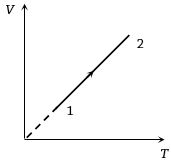
Volume versus temperature graph of two moles of helium gas is as shown in figure. The ratio of heat absorbed and the work done by the gas in process $1-2$ is
Two gases-argon (atomic radius $0.07 \;\mathrm{nm}$,atomic weight $40$ ) and xenon (atomic radius $0.1\; \mathrm{nm},$ atomic weight $140$ ) have the same number density and are at the same temperature. The raito of their respective mean free times is closest to
The angular velocity of the engine (and hence of the wheel) of a scooter is proportional to the petrol input per second. The scooter is moving on a frictionless road with uniform velocity. If the petrol input is increased by 10%, the linear velocity of the scooter is increased by: